
Issue 246 – 28 May 2026

|
Welcome to Practice Connect, a fortnightly update for practice managers, principals, nurses and administration staff on relevant issues, upcoming events and education. |
Chronic conditions – feature
Chronic conditions remain a major health challenge in Australia

Chronic conditions are a significant health concern in Australia, affecting nearly two-thirds of the population (about 15.4 million people) in 2022 and accounting for 90 percent of all deaths (Australian Institute of Health and Welfare 2024).
Chronic conditions are not evenly distributed across the population and increase sharply with age. People living in more disadvantaged areas and those outside major cities are more likely to report having one or more long-term conditions.
Most chronic condition care is delivered in general practice, with GPs and allied health professionals playing a central role. Psychological concerns, musculoskeletal conditions and metabolic disorders such as diabetes are now the most common reasons for GP presentations.
The Australian Government has developed a range of chronic disease management resources to enhance quality improvement in the management of patients with chronic conditions including:
WA Primary Health Alliance commissions services from various community and health providers. Learn about our chronic conditions priorities and access our care strategy here.
For further support on MyMedicare and Chronic Condition Management resources, contact Practice Assist or your Primary Care Navigator on 08 6278 7900 or via email practiceassist@wapha.org.au
Managing chronic health conditions with a shared health summary in My Health Record

As your clinical team supports your patients in managing chronic health conditions, they are encouraged to upload a shared health summary to the patient’s My Health Record (MHR) after a consultation.
A shared health summary includes key clinical information such as medical diagnosis, medications, immunisations and allergies. This helps ensure that relevant information is readily accessible to other healthcare professionals involved in the patient’s broader care team, supporting continuity of care and improved health outcomes.
Sharing a health summary allows patients to conveniently access their important health information, supporting active self-management through 1800MEDICARE, a secure and user-friendly way for them to stay informed about their care. Updates from health providers include pathology, radiology test results, hospital discharge summaries and advanced care plans.
For additional information and support on using MHR in your practice, contact Practice Assist or your Primary Care Navigator on 08 6278 7900 or via email practiceassist@wapha.org.au
Practice news
Primary Sense – Best Practice Halo Connect Integration action required by 30 June 2026

General practices that use Best Practice (BP) Premier practice management software will need to take action to ensure continued connectivity with the Primary Sense data extraction and clinical decision support tool.
Halo Connect is the supported method for enabling secure, real-time access between BP Premier and Primary Sense.
Primary Sense extractions will cease if Halo Connect integration is not completed by 30 June 2026. This will impact on PIP QI data submissions and in-practice use of Primary Sense for reports, prompts and alerts.
Communications will be sent to all WA practices impacted by this change along with detailed instructions to successfully complete the connection. Alternatively see the Primary Sense Best Practice Halo Connect Practice Guide for step-by-step instructions.
For further support please contact primarysense@wapha.org.au, your Primary Care Navigator or call Practice Assist on 08 6278 7900.
Designated registered nurse (RN) prescribing scholarships available
|
Are you a registered nurse with at least three years of full-time clinical experience within the past six years? Do you work with an authorised healthcare practitioner who is an independent prescriber: Medical Practitioner or Nurse Practitioner? Could your practice and patient cohort benefit from improved access to prescription medicines? |
The Chief Nursing and Midwifery Office is delighted to collaborate with Edith Cowan University to offer 20 full scholarships for registered nurses undertaking the newly accredited ‘Graduate Certificate in Designated Registered Nurse (RN) Prescribing’.
Empowering RNs to gain prescribing endorsement creates a new pathway for patients to access medicines safely and effectively, while improving access to essential healthcare services, particularly for vulnerable populations and those living in regional, rural and remote communities.
Designated RN prescribing represents a natural progression of the RN role. Globally, nurse prescribing has been recognised for over 50 years as a safe and complementary practice.
It is important to note that Designated RN Prescribers must prescribe in partnership with an authorised health practitioner and under a formal prescribing agreement.
To find out more about the graduate certificate, eligibility, scholarship and the requirements of your workplace and authorised prescribers please access the links below:
- Designated registered nurse prescribing
- Scholarships offered (under Designated registered nurse prescriber tab)
Scholarship applications for semester two 2026 intake are now open, and close at 4pm on 29 June 2026.
Help evaluate a new online tool for endometriosis care
Researchers at Macquarie University Sydney are conducting a study to evaluate a new online decision support tool for patients over the age of 18 who have been diagnosed with or are strongly suspected of having endometriosis.
Eligible patients will be given access to the online tool, called EndoOptions and need to complete four online questionnaires over six months to receive a $50 gift voucher.
To find out more, refer to the overview for clinicians, download the waiting-room poster or visit the EndoOptions research study webpage.
For further information about the study, email Professor Kerry Sherman via kerry.sherman@mq.edu.au or Lynda Fallon via lynda.fallon@hdr.mq.edu.au
Care finder services: updated providers and referrals

The care finder service is a free service for older people who need intensive support to access aged care and other services.
Care finder services continue to be available across WA, with some changes to service providers in progress.
When to refer:
- Difficulty navigating aged care
- Social isolation or limited supports
- Complex needs
- Reluctance to engage
Full eligibility criteria here.
How to refer:
Perth Metropolitan: active care finder service providers
| Perth North and Perth South PHN | Referral Phone/email | |
| Advocare Incorporated | (08) 9479 7566 or 1800 655 566 | |
| Chung Wah Association | (08) 9328 3988 or enquiry@chungwahcc.org.au | |
| People Who Care | (08) 9379 1944 or 0447 042 108 carefinder@peoplewhocare.org.auor referrals@peoplewhocare.org.au |
|
| Tuart Place (open for intake from 1 July 2026) | (08) 6140 2380 or 1800 619 795 welcome@tuartplace.org |
|
| Umbrella Multicultural Community Care | (08) 9275 4411 or 0413 638 124 cfs@umbrellacommunitycare.com.au |
| Country WA: Current providers remain in place until 30 June 2026, with updates to follow. More information, including contact details for country WA services is available at My Aged Care. |
Provider Connect Australia™ – How to publish to business partners
Provider Connect Australia (PCA), an initiative of the Australian Digital Health Agency, enables healthcare provider organisations to maintain their business information in one place. This helps keep service and practitioner details accurate, reduces duplication, streamlines notifications, and makes it easier to share updates with business partners while lowering effort and errors.
Watch this short video for an overview of how PCA Works (46-seconds).
If your general practice is already registered for Provider Connect Australia (PCA), follow these steps to publish your practice details to your business partners.
- Log in to the PCA portal
- Click the Publishing icon in the blue sidebar or select Manage in the publishing settings tile
- Click Add
- Select the business partners you want to publish to
- Choose the information you want to share
- Read and accept the information use statements
- Click Publish
For further support, visit the Digital Health website, email digitaladoptionsupport@health.gov.au, or contact Practice Assist or your Primary Care Navigator on 08 6278 7900 or via email practiceassist@wapha.org.au
MyMedicare and Medicare updates
MyMedicare Minute from the Department of Health, Disability and Ageing
|
MyMedicare Minute – Six One key message. One minute to read. |
The value of HPOS messaging
|
What practices need to know
|
Resources
Step-by-step guidance, videos and training through the Services Australia Health Professional Education (HPE) portal. |
Immunisation updates
FluMist ordering

FluMist is available for immunisation providers to order through their practice’s Onelink account. Since the program began, 49,200 doses have been distributed to providers, with 15,407 doses reported in the Australian Immunisation Register (AIR).
Effective from 16 April, the order limit has been increased to 200 doses per week.
If your practice requires more than 200 doses per week, please email vaccineorders@health.wa.gov.au, or write a note in the ‘Notes’ field in your Onelink order requesting the additional stock and reason why (for example, ‘practice has two influenza clinics scheduled’ or ‘an increase in bookings for children aged two to 11 years of age’).
New annual AIR due and overdue rules for influenza
The Australian Immunisation Register (AIR) has introduced annual due and overdue rules for influenza vaccines. If no influenza vaccine has been recorded since 1 March in the current year, the vaccine will show as due from 1 May and overdue from 1 June.
These rules help vaccination providers identify people who may be eligible for a free influenza vaccine under the National Immunisation Program (NIP). The AIR will issue overdue reminder letters each year from 1 June to 30 September, in line with Australian Immunisation Handbook (AIH) advice on peak influenza circulation.
Each year, these due and overdue rules apply to people eligible for a NIP-funded influenza vaccine, including:
- Aboriginal and Torres Strait Islander people aged 6 months and over
- Children aged 6 months to under 5 years
- People aged 65 years and over
However, the AIR cannot identify every cohort or clinical circumstance in which a person may qualify for a free NIP influenza vaccine. As a result:
- Some eligible people will not appear as due for influenza in the AIR, such as pregnant women and people with certain medical conditions.
- Only one dose per year will display as due, even when two doses are clinically recommended.
These AIR due and overdue rules are a guide only.
Before vaccinating, immunisation providers should refer to the AIH and the ATAGI Statement on the administration of seasonal influenza vaccines for the latest clinical recommendations.
Updates to AIR due and overdue rules for childhood pneumococcal vaccines for Aboriginal and Torres Strait Islander children
The Australian Immunisation Register (AIR) due and overdue rules for pneumococcal are being updated to align with the National Immunisation Program (NIP) schedule for Aboriginal children. These changes apply only to Aboriginal children who turn 6 months old on or after 28 April 2026.
This enhancement means eligible children will appear as due in the AIR for the additional pneumococcal dose recommended at 6 months of age. Any pneumococcal vaccine given at 6 months will appear under the correct schedule on the child’s Immunisation History Statement (IHS). If an Aboriginal child does not receive the additional recommended dose at 6 months, it will not:
- Change the child’s NIP immunisation status; they will still display as ‘up-to-date’
- Affect Family Assistance payments
Vaccination providers will be able to see when a Aboriginal child is due for a pneumococcal vaccine in:
- The AIR site
- Clinical information software integrated with the AIR
Providers will also be able to run due and overdue pneumococcal vaccine reports through the AIR site, as they do for other NIP vaccines. This will help identify children who may need catch-up vaccination.
Services Australia has published the updated National due and overdue rules for immunisation.
More information about these updates is available here.
EOI for HESA accredited Immunisation Course – ‘Understanding Vaccines and the National Immunisation Program’
WA Primary Health Alliance (WAPHA) is supporting nurses in general practice, aged care and Aboriginal health to complete the ‘Understanding Vaccines and the National Immunisation Program’ Health Education Services Australia (HESA) accredited training program.
This expression of interest (EOI) is for registered nurses, enrolled nurses, nurse practitioners and Aboriginal health practitioners who require training on immunisation. Please read the information below before completing the EOI survey.
To apply, registered and enrolled nurses and Aboriginal health practitioners must be:
- registered with AHPRA; and
- currently employed in residential aged care homes (RACHs) providing COVID-19 vaccination; or
- currently employed in a relevant health setting providing COVID-19 vaccination.
Access the EOI: Understanding Vaccines and the National Immunisation Program.
For all queries, email the WAPHA Immunisation team at immunisation@wapha.org.au
Australian Centre for Disease Control updates guidance as the Department of Health, Disability and Ageing announces a diphtheria outbreak support package
The first suspected diphtheria-related death in Australia in almost a decade has been reported in the Northern Territory, with cases continuing to be identified in Western Australia and other states. At time of publication, 90 cases of diphtheria have been reported in WA.
The Australian Centre for Disease Control (CDC) and Communicable Diseases Network Australia have developed Interim guidance for diphtheria outbreak management for state and territory public health units.
The Australian CDC is also advising travellers to higher-risk areas to check their vaccination status and consider vaccination if they have not received a diphtheria containing vaccine in the past 5 years.
Recent public health alerts have also been issued – Diphtheria alert for regional Western Australia.
To support the response, the Australian Government Department of Health, Disability and Ageing has announced a support package, including:
- booster vaccinations and treatment
- National Aboriginal Community Controlled Health Organisation funding to support culturally safe communication and outreach in the NT and affected states.
Further information available here.
Quality improvement
RSV Awareness Week 2026 – Quality improvement activity

Respiratory Syncytial Virus (RSV) Awareness Week takes place from 7 to 13 June.
This year’s theme, ‘Don’t Let Them Go Unprotected’, calls for action to protect Australians most at risk of severe RSV.
Held at the start of winter, RSV Awareness Week highlights the increased risk of RSV across Australia. RSV can cause serious illness, especially in babies, older adults and other high-risk groups.
Protecting vulnerable people is a shared responsibility. By working together, we can reduce the impact of RSV on families and communities.
Everyone can help, including individuals, healthcare professionals and organisations:
- Increase awareness of RSV and its effects
- Share trusted, evidence-based information
- Promote RSV protection for infants and older adults
Quality improvement activity
This is an ideal time for your practice to complete a quality improvement activity on infant RSV. Access the PDSA here.
Resources
The WA Department of Health has released a helpful decision aid for RSV eligibility, embedded in the WA Immunisation Schedule or available here.
More information, a toolkit and posters are available from the Immunisation Foundation of Australia.
Education and events
Health assessments made easy: Turning reports into patient results
Presented by WA Primary Health Alliance
3 June (12pm to 1pm)

Join us for this practical, quality improvement (QI) webinar that will focus on enhancing health assessments to support preventative, proactive patient care in general practice.
To find out more, view the flyer and register today.
Quality improvement (QI) webinars:
Catch up on previous webinar sessions by visiting the Quality Improvement YouTube series.

View our QI Bites videos – Primary Sense in Practice:
- Video 1: Accreditation Report
- Video 2: Health Assessments Report
- Video 3: PIP QI 10 Measures Report
- Video 4: CVD Patients for Screening, Recall and Treatments Report
Practice Manager Virtual Networking – June
Presented by WA Primary Health Alliance
4 June (11am to 12pm)

Join us at our third Practice Manager Virtual Networking Session, which will provide an opportunity for you to connect, discuss topics of interest, share information and raise questions with your WAPHA support team and other local general practices. These sessions will be held every two months.
When you register for each virtual session, you can indicate which topics you would like to be discussed by using the free text box.
To make the most of these interactive virtual sessions, you will need to have access to a microphone and camera, if possible.
To find out more, view the flyer and register today.
Webinar 3: Conducting a comprehensive refugee health assessment
Presented by WA Primary Health Alliance
18 June (6pm to 7pm)
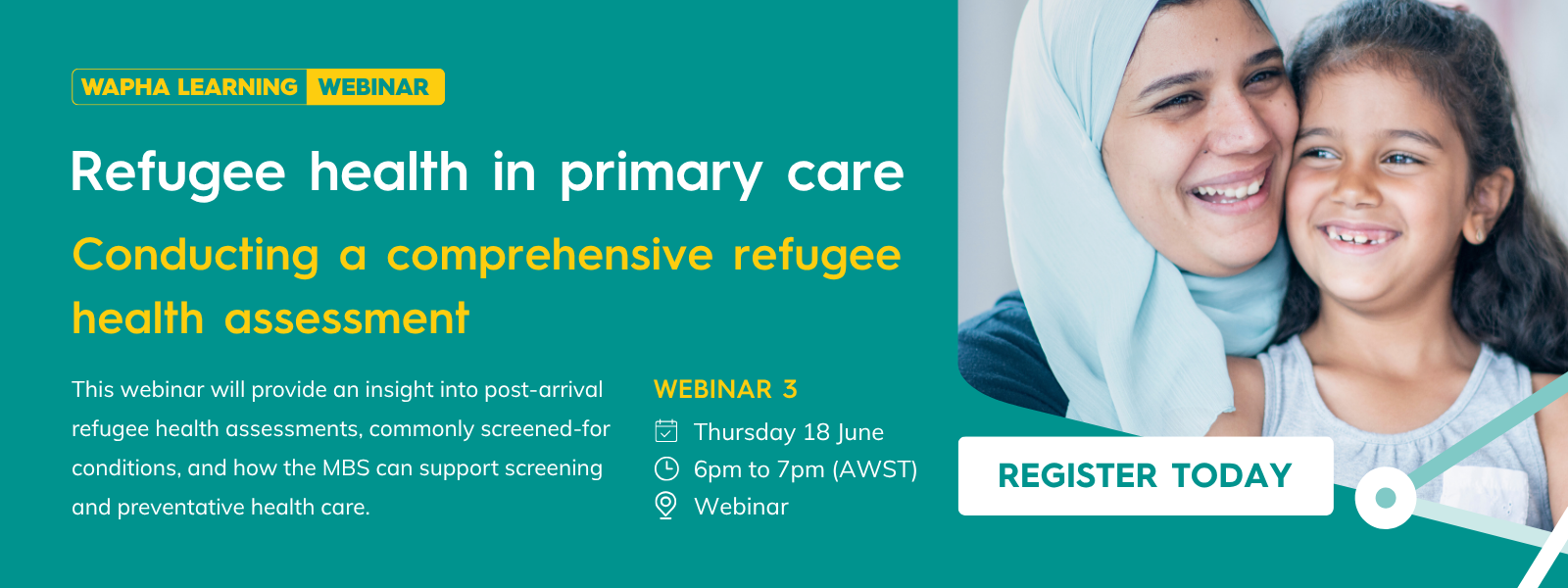
Join us for the third webinar in this six-part series, presented in conjunction with WA Health.
This webinar will provide an insight into post-arrival refugee health assessments, commonly screened-for conditions in WA refugee arrivals, and how the Medicare Benefits Schedule (MBS) can support screening and preventative health care for refugees.
To find out more, view the flyer and register today.
Webinar: Managing chronic kidney disease (CKD) in primary care
Presented by WA Primary Health Alliance
25 June (6.30pm to 7.30pm)

GPs and other primary health care clinicians are invited to join us for the second webinar in this series with Kidney Health Australia.
This webinar will take a deep dive into managing chronic kidney disease (CKD) with a focus on chapter two of the CKD Management in Primary Care handbook (5th edition).
To find out more, view the flyer and register today.
Other Webinars, Events & Workshops
| Sexual Health and BBV Management and Care for Nurses and Midwives Presented by ASHM 2 June, 4 June, 9 June and 11 June |
| BreastScreen WA mobile visit to Butler Presented by BreastScreen WA 10 June to 23 December |
| BreastScreen WA mobile visit to Kojonup Presented by BreastScreen WA 10 June to 22 June |
| Advanced Training in Suicide Prevention – Blended Learning Presented by Black Dog Institute 11 June |
| BreastScreen WA mobile visit to Karratha Presented by BreastScreen WA 11 June to 6 July |
| BreastScreen WA mobile visit to Rangeway (Geraldton) Presented by BreastScreen WA 16 June to 18 June |
| BreastScreen WA mobile visit to Geraldton Presented by BreastScreen WA 19 June to 12 January |
| Talking About Suicide Prevention in Practice – Webinar Presented by Black Dog Institute 20 June |
| BreastScreen WA mobile visit to Cranbrook Presented by BreastScreen WA 23 June to 25 June |
| Pornography and impact on women’s health webinar Presented by Women’s and Newborn Health Service 24 June |
| BreastScreen WA mobile visit to Tambellup Presented by BreastScreen WA 26 June to 29 June |
| BreastScreen WA mobile visit to Gnowangerup Presented by BreastScreen WA 30 June to 3 July |
| Viral Hepatitis in Primary Care Day – Scholarships available Presented by ASHM 4 July |
| BreastScreen WA mobile visit to Booragoon Presented by BreastScreen WA 6 July to 7 August |
| FDV safety planner webinar Presented by Women’s and Newborn Health Service 12 August |
| Aboriginal Health Conference 2026 Presented by Rural Health West 16 August |
Acknowledgement
WA Primary Health Alliance acknowledges and pays respect to the Traditional Owners and Elders of this country and recognises the significant importance of their cultural heritage, values and beliefs and how these contribute to the positive health and wellbeing of the whole community.