
Issue 245 – 14 May 2026
|
Welcome to Practice Connect, a fortnightly update for practice managers, principals, nurses and administration staff on relevant issues, upcoming events and education. |
Practice news
Formal guidance for clinicians on the use of artificial intelligence tools

Artificial Intelligence (AI) tools have the potential to support a wide range of clinical tasks. While they cannot replace GPs’ work in preparing clinical documentation, they can assist by automating parts of the documentation process.
The Australian Commission on Safety and Quality in Health Care (ACSQH) has developed formal guidance and associated clinical scenarios to support clinicians, together with their patients, in using AI safely and responsibly in patient care.
Download the guide from the ACSQHC website.
The RACGP has also developed a fact sheet to assist GPs and practice teams in understanding the potential advantages, disadvantages and administrative considerations of implementing AI scribes in their practice.
MBS health assessments

Health assessments help general practices identify health risks and detect disease earlier, supporting preventive care and improved population health. Completing the relevant assessments also enables earlier, evidence-based intervention to prevent or better manage conditions such as cardiovascular disease and diabetes.
For information on MBS health assessment updates effective from March 2026, refer to the March 2026 News and Technical changes to time-tiered MBS health assessment items.
Time-tiered health assessment items are only available to specific patient cohorts. Details of the requirements for a health assessment for each patient cohort are via the MBS online explanatory notes:
- Type 2 diabetes risk evaluation (40-49 years) – see 0.37
- Health assessment for people aged 45-49 years (inclusive) who are at risk of developing chronic disease – see 0.38
- Health Assessment provided for people aged 75 years and older – see 0.39
- Health Assessment provided as a comprehensive medical assessment for residents of residential aged care facilities – see 0.40
- Health Assessment provided for people with an intellectual disability – see 0.41
- Health Assessment provided for refugees and other humanitarian entrants – see 0.42
- One-off health assessment for veterans – see 0.69
Other Health Assessments which are not time dependent are:
- Aboriginal and Torres Strait Islander people’s health assessment – see 0.43
- Heart health assessment – see 14.2
- Menopause and perimenopause health assessment – see 14.3
Practices using the Primary Sense data extraction and decision support tool can use built-in reports to identify patients eligible for health assessments. Our Primary Sense Health Assessment Report factsheet explains how to run the reports and suggests quality improvement activities for your practice.
Resources:
- Practice Assist MBS page: Care Plans and health assessments.
- Services Australia: Health assessments.
- RACGP Guide for health assessments.
- RACGP 1 March 2026 MBS updates.
- Medicare Benefits Schedule – Note AN.0.36.
- Improving the implementation of annual health assessments for people with intellectual disability.
- Menopause and perimenopause health assessment services.
For further information or resources on MBS health assessments, contact Practice Assist or your Primary Care Navigator on 08 6278 7900 or via email practiceassist@wapha.org.au
Upcoming webinar: Health assessments made easy: Turning reports into patient resultsPresented by WA Primary Health Alliance Join us for this practical, quality improvement (QI) webinar that will focus on enhancing health assessments to support preventative, proactive patient care in general practice. To find out more, view the flyer and register today. |
MyMedicare and Medicare updates
MyMedicare Minute from the Department of Health, Disability and Ageing
|
MyMedicare Minute – Refresher One key message. One minute to read. |
MyMedicare strengthens continuity of care with a patient’s regular practice, while still allowing patients to attend any practice for care when needed.
What practices need to know
Resources We encourage you to utilise the Department of Health, Disability and Ageing or Services Australia websites for more information. |
Immunisation updates
Rapid Antigen Test kits for general practice staff
WA Primary Health Alliance recognises the importance of staff health and wellbeing during the winter season.
This initiative helps detect COVID-19 and other respiratory illnesses early among practice staff, allowing them to quickly receive advice, testing, and treatment.
Early detection reduces the risk of severe illness, hospitalisation, and potentially death.
It also enables swift infection prevention and control measures to limit the spread to other staff, patients, and the wider community throughout the winter.
General practices across Western Australia can request free Rapid Antigen Test kits (RATs) through the Expression of Interest (EOI) form below.
The number of RATs provided will depend on the staff numbers at each practice location, and distribution is based on need and available supply.
Access the EOI here: General practice RAT distribution.
The EOI closes on 30 May 2026.
EOI for HESA accredited Immunisation Course – ’Understanding Vaccines and the National Immunisation Program’

WA Primary Health Alliance (WAPHA) is supporting nurses in general practice and aged care, and Aboriginal health practitioners to complete the ‘Understanding Vaccines and the National Immunisation Program’ Health Education Services Australia (HESA) accredited training program.
This expression of interest (EOI) is for registered nurses, enrolled nurses, nurse practitioners and Aboriginal health practitioners who require training on immunisation.
The program aims to equip health professionals with knowledge and skills to competently deliver a high quality and safe immunisation service.
It is self-paced learning and must be completed within a period of 20 weeks from the date of registration.
To apply, Nurses and Aboriginal Health Practitioners must be:
- Registered with AHPRA; and
- Currently employed in residential aged care homes (RACHs) where vaccinating against COVID-19 is occurring; or
- Currently employed in a relevant health setting where vaccinating against COVID-19 is occurring.
Access the EOI here:Express your interest in Understanding Vaccines and the National Immunisation Program.
For all queries, please email the WAPHA Immunisation team on immunisation@wapha.org.au
‘Vaccination is the best preparation’ – national immunisation campaign launch

The Australian Government Department of Health, Disability and Ageing has launched two campaigns to address declining vaccination rates:
Childhood immunisation provides essential vaccine information for parents and shares a video on losing a child to pneumococcal disease.
Winter vaccination encourages older Australians to get vaccinated against influenza, RSV, and COVID-19.
WA Health diphtheria outbreak response
There have been sixty confirmed cases of diphtheria reported in regional WA since the outbreak began in late December 2025.
The WA Immunisation Schedule and WA Aboriginal Immunisation Schedule have been updated to include expanded eligibility for diphtheria-containing vaccines.
Aboriginal people living in the Kimberley, Pilbara or Goldfields, and patient-facing healthcare workers in these regions, are encouraged to receive a state-funded diphtheria-containing booster vaccination if it has been more than 5 years since their last dose.
Immunisation providers are also encouraged to ensure all children and adolescents are up to date with their scheduled diphtheria-containing vaccines under the National Immunisation Program (NIP). This includes the School-Based Immunisation Program, with proactive review and vaccination during healthcare encounters and active recalls where feasible.
Ordering of additional Tetanus, Diphtheria and Pertussis (dTpa) is currently limited to immunisation providers in the Kimberley, Pilbara or Goldfields regions, but will be monitored and expanded as required.
Providers can use existing NIP-funded vaccines already available while awaiting delivery of outbreak-specific stock, and report this use via an online form to support replenishment from state-funded supply.
Please do not order NIP vaccines for this purpose.
The Education Requirements for Immunisation Provision table found on the WA Health Immunisation education page has been updated to include the education requirements for administering diphtheria-containing vaccines.
Also see the resources below for further information:
Watch now – RSV vaccines and prevention programs: evidence, safety and impact
Video recordings from the National Centre of Immunisation and Research Surveillance (NCIRS) recent online webinar, ‘RSV vaccines and prevention programs: evidence, safety and impact,’ are now available on the NCIRS website.
To support providers and professionals as they prepare for the upcoming respiratory illness season, immunisation experts presented information on several key topics.
- The inclusion of the respiratory syncytial virus (RSV) vaccine Arexvy on the National Immunisation Program (NIP) for adults aged 75 and over and Aboriginal and Torres Strait Islander people aged 60 and over from 15 May 2026.
- Available RSV immunisation products, with up-to-date data on effectiveness, safety and uptake.
- Real-world case studies and practical tips for discussing RSV vaccination with patients, particularly older adults.
Access the webinar recording here.
Quality improvement

Turning PIP QI data into action – Influenza vaccination in diabetes
Managing chronic conditions such as diabetes involves more than monitoring symptoms and reviewing care plans. Preventative care plays a crucial role in reducing complications, hospital admissions and long-term health risks, with annual influenza vaccination being one of the simplest and most effective interventions available.
The Practice Incentives Program – Quality Improvement (PIP QI) includes influenza vaccination measures for patients aged 15 years and over with diabetes. These measures allow practices to review the effectiveness and documentation of their preventative care, rather than just focusing on meeting reporting obligations.
Our quality improvement (QI) activity for this month provides a Plan, Do, Study, Act (PDSA) template to help practices work towards increasing the recording of influenza immunisation in this patient cohort. The PDSA can be adapted to work towards improving influenza immunisation rates in other chronic conditions.
If you would like assistance running this activity, contact your local QI Coach or email the QI Team at qi@wapha.org.au
Access the QI Activity: PDSA Increase Influenza immunisation for patients with Diabetes.
Cancer screening updates
New video and template for the National Lung Cancer screening program

The ‘It’s Good to Know’ campaign is a national awareness campaign that supports the launch of the National Lung Cancer Screening Program (NLCSP), aiming to increase awareness and participation among eligible Australians. As part of the campaign a new screening video, as well as editable poster and social tile templates are now available to use in your practice.
Lung screening video – Aunty Joan Quinlan
In the newly released video Aunty Joan shares her personal experience with lung screening. By recounting her own journey, she helps the mob understand what to expect when undergoing a low-dose CT scan as part of the NLCSP.
Learn more: ‘It’s just part of looking after myself’: Aunty Joan’s lung screening story.
Watch: Aunty Joan’s lung cancer screening experience.
Editable templates available – posters and social tiles
Editable templates have been developed to support Aboriginal Community Controlled Organisations (ACCHOs) and other health providers. These resources enable you to co-brand campaign materials and tailor the call to action to suit practice needs.
Templates are accessible via Canva:
How to use the templates:
Click ‘View template’ then ‘Open in editor’ to access and edit the templates in Canva. This downloads a copy into your Canva account, allowing you to add your practice’s logo and refine the call to action.
You can also find ready-to-use promotional materials in the Campaign Toolkit for Aboriginal and Torres Strait Islander communities.
Promote lung cancer screening in your practice and win!
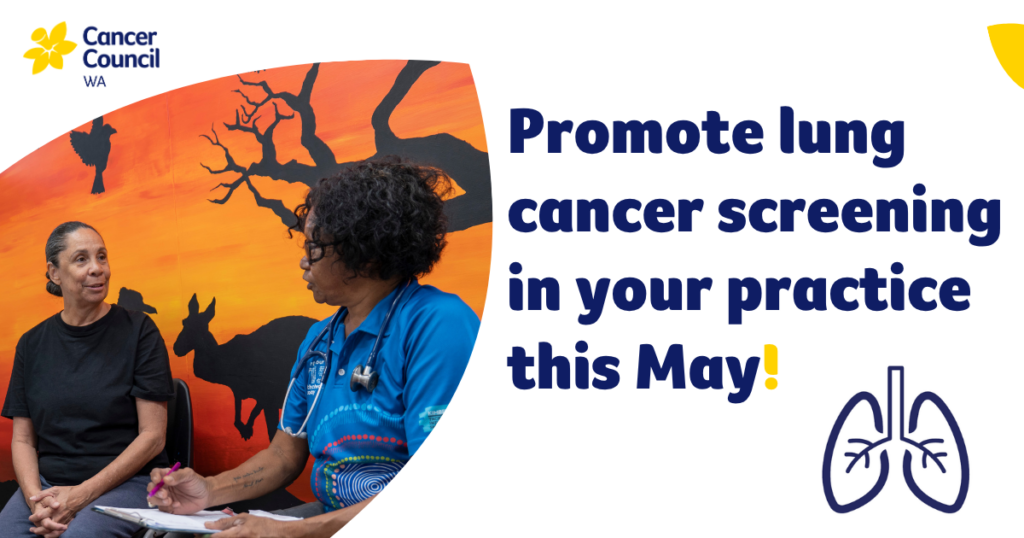
Cancer Council WA, WA Health and WA Primary Health Alliance invite your practice to help raise awareness of the National Lung Cancer Screening Program (NLCSP) by hosting a waiting room display during May 2026.
By setting up a display in your practice you can help patients understand the importance of lung cancer screening, who is eligible, how it works and why early detection can save lives.
How to get involved:
- Order a free resource pack for your display via the order form.
- Set up your NLCSP display in your waiting room during May 2026.
- Send a photo of your display to gp@cancerwa.asn.au by 15 June 2026 to be entered into the competition.
Win a prize!
- Every practice that submits a photo will receive a $25 gift card.
- The major prize, a $300 gift card, will be awarded to the display judged to be most creative, innovative and reflective of overall effort. The winner will be chosen by WA Health and notified on 17 June by 5:00pm (AWST).
Health promotion event
National Palliative Care Week is 10 to 16 May 2026
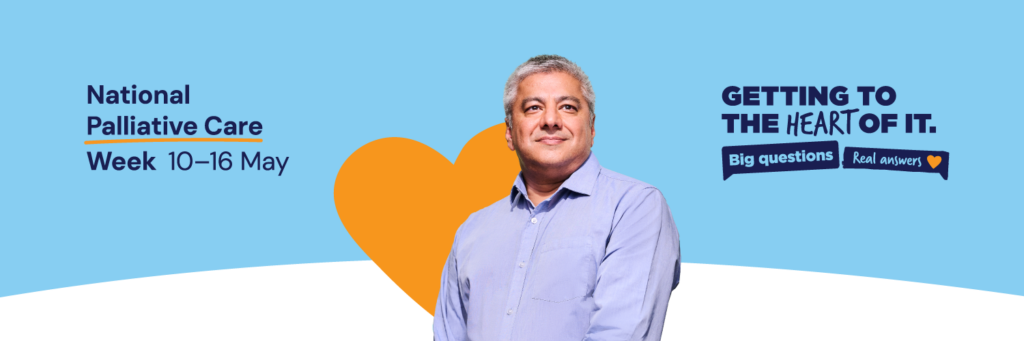
This National Palliative Care Week, Palliative Care Australia invites Australians to start conversations and raise awareness. It also encourages advocacy for better access to and acceptance of palliative and end‑of‑life care.
The 2026 campaign, ‘Getting to the heart of it’ empowers earlier conversations and connecting people to trusted information, tools and support.
Why conversations about palliative care matter:
Starting a conversation about palliative care early allows time to ask questions, understand options and plan for what matters most. It is better to talk sooner than to have choices narrowed when time is shorter.
Help spread the word and continue to build a better understanding of palliative and end-of-life care:
- Download and share campaign resources.
- Promote NPC Week 2026 through your practice’s communication channels.
- Encourage conversations about palliative care.
Education and events
Health assessments made easy: Turning reports into patient results
Presented by WA Primary Health Alliance
3 June (12pm to 1pm)

Join us for this practical, quality improvement (QI) webinar that will focus on enhancing health assessments to support preventative, proactive patient care in general practice.
To find out more, view the flyer and register today.
Quality improvement (QI) webinars:
Catch up on previous webinar sessions by visiting the Quality Improvement YouTube series.

View our QI Bites videos – Primary Sense in Practice:
- Video 2: Health Assessments Report
- Video 3: PIP QI 10 Measures Report
- Video 4: CVD Patients for Screening, Recall and Treatments Report
Practice Manager Virtual Networking – June
Presented by WA Primary Health Alliance
4 June (11am to 12pm)

Join us at our third Practice Manager Virtual Networking Session, which will provide an opportunity for you to connect, discuss topics of interest, share information and raise questions with your WAPHA support team and other local general practices. These sessions will be held every two months.
When you register for each virtual session, you can indicate which topics you would like to be discussed by using the free text box.
To make the most of these interactive virtual sessions, you will need to have access to a microphone and camera, if possible.
To find out more, view the flyer and register today.
Other Webinars, Events & Workshops
| BreastScreen WA mobile visit to Three Springs Presented by BreastScreen WA 11 May to 18 May |
| Understanding voluntary assisted dying in practice Presented by the Department of Health End-of-Life Care Program 15 May (session one) and 18 September (session two) |
| Dealing with Depression in Rural Australia – Blended Presented by Black Dog Institute 18 May |
| Addressing rising rates of congenital syphilis Presented by University of Melbourne 19 May |
| BreastScreen WA mobile visit to Port Denison Presented by BreastScreen WA 19 May to 15 June |
| The Big 5 – Simple Steps for Better Mental Health (Kalgoorlie) Presented by MindSpot GP, WA Primary Health Alliance and Goldfields Health Professionals Network 20 May |
| BreastScreen WA mobile visit to South Hedland Presented by BreastScreen WA 21 May to 9 June |
| Vaccinations for Special Risk Groups Presented by RACGP WA and WA Department of Health 26 May |
| Sexual Health and BBV Management and Care for Nurses and Midwives Presented by ASHM 2 June, 4 June, 9 June and 11 June |
| BreastScreen WA mobile visit to Kojonup Presented by BreastScreen WA 10 June to 22 June |
| Advanced Training in Suicide Prevention – Blended Learning Presented by Black Dog Institute 11 June |
| BreastScreen WA mobile visit to Karratha Presented by BreastScreen WA 11 June to 6 July |
| BreastScreen WA mobile visit to Rangeway (Geraldton) Presented by BreastScreen WA 16 June to 18 June |
| BreastScreen WA mobile visit to Geraldton Presented by BreastScreen WA 19 June to 12 January |
| Talking About Suicide Prevention in Practice – Webinar Presented by Black Dog Institute 20 June |
| Viral Hepatitis in Primary Care Day – Scholarships available Presented by ASHM 4 July |
| Aboriginal Health Conference 2026 Presented by Rural Health West 16 August |
Acknowledgement
WA Primary Health Alliance acknowledges and pays respect to the Traditional Owners and Elders of this country and recognises the significant importance of their cultural heritage, values and beliefs and how these contribute to the positive health and wellbeing of the whole community.