
Issue 243 – 17 April 2026
|
Welcome to Practice Connect, a fortnightly update for practice managers, principals, nurses and administration staff on relevant issues, upcoming events and education. |
Medicare and MyMedicare updates
MyMedicare patient registration
How to streamline the process and ensure your practice meets eligibility
Seeing a GP regularly and formalising the relationship your patients have with their GP and practice through MyMedicare can lead to better health outcomes.
Patients can be registered in multiple ways:
- The MyGov app is the most streamlined approach for patients to register for MyMedicare. Patients with Smart Phone access and capabilities can register using the MyGov app and with auto approve selected there is no administrative tasks required for the practice.
- The MyMedicare form can be used for patients who do not have access to the app. You may consider having these forms pre-populated using your software to assist with streamlining the process. Ensure these forms are saved and stored in line with the legislation for a minimum of seven years.
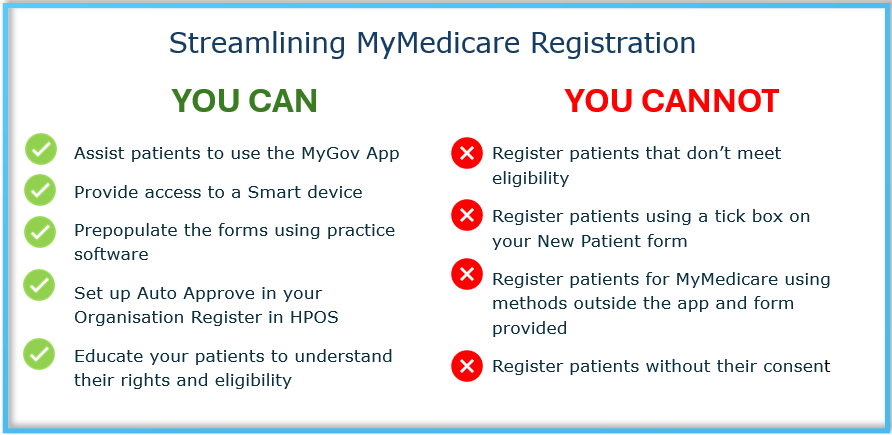
It is important to ensure that when registering patients at your practice they meet the eligibility and have completed the required documentation. If intending to use online booking platforms for registration, consider if it is appropriate for all patients or just those that meet the eligibility criteria.
Patients are eligible to be registered for MyMedicare if they have both:
Eligibility exemption applies only to: People who are facing hardship, this includes people experiencing domestic and family violence and homelessness. |
| For detailed explanation of the MyMedicare program see MyMedicare Program Guidelines and the Services Australia HPE Package MYMEDM02 – MyMedicare – Managing patient registrations.
Feedback about the MyMedicare program can be provided to Services Australia and should be directed to the specific method as listed : Patient Feedback , Businesses and Health Professionals. |
Second Bulk Billing Practice Incentive Program payments may include reassessments
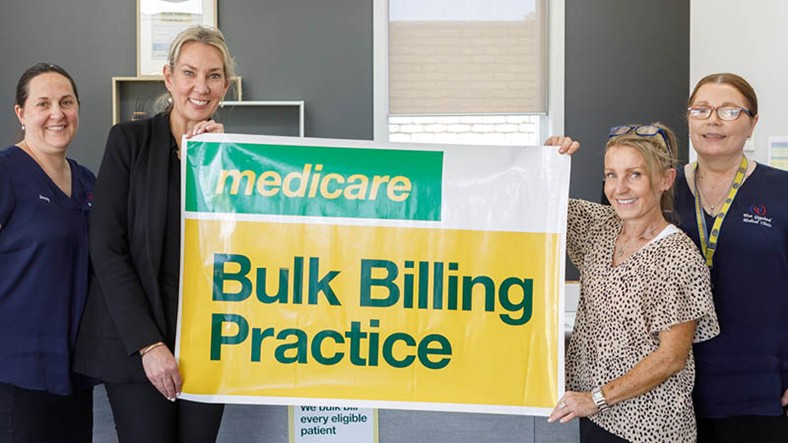
The second quarterly Bulk Billing Practice Incentive Program (BBPIP) payments may include reassessments. Payments are expected to appear in the bank accounts of registered practices and providers in April.
The second quarterly Bulk Billing Practice Incentive Program payments may include reassessments to correct underpayments or overpayments that were not included in the previous payment, such as:
- Late or amended claims.
- A change in a practice’s eligibility.
- Administrative error.
Reassessments allow payments to be updated when new or corrected claims are submitted, ensuring practices and providers receive the correct entitlement over time. Practices and providers can check their payment details through Services Australia’s Health Professional Online Services (HPOS) and will also receive a payment notice in their HPOS email inbox showing any reassessment as a separate line item.
If a practice or GP believes the payment or reassessment is incorrect, they should contact Services Australia on 132 150 (option 2).
Visit the Services Australia website for more information.
Medicare Mental Health HealthLink GP SmartForm now available
While no referral is needed for a person to access Medicare Mental Health, referrals are welcomed from GPs, primary health care professionals, local hospital and health service providers and non-government organisations. Find out more about working alongside Medicare Mental Health services here.
What is the Medicare Mental Health eReferral?
The Medicare Mental Health eReferral provides a secure, electronic way for both GP and non-GP referrers to submit referrals directly into the Medicare Mental Health intake system. It reduces reliance on email or fax referrals and supports more complete, consistent referral information.
Why was it created?
- To simplify the referral process for referrers.
- To reduce incomplete referrals and follow-up.
- To support faster triage and access to services.
- To provide a consistent, standardised referral pathway across regions.
- To close the referral loop, allowing referrers to receive confirmation and track referral status in real time.
How to access?
- GPs can refer using the HealthLink SmartForm within their clinical software.
- As of Monday 13 April 2026, online eReferral webforms for non-GP referrers and services that do not use HealthLink are also available, using region specific links below:
Watch a demonstration video that guides you through the referral process in HealthLink. Unsure of your Primary Health Network? Access the PHN locator.
For more support
For support related to the HealthLink SmartForm, contact 1800 125 036 or HelpdeskHL@healthlink.net
MyMedicare Minute from the Department of Health, Disability and Ageing
|
MyMedicare Minute – Week Four One key message. One minute to read. |
|
Nominate your bank account to receive MyMedicare incentives.
What practices need to know
Resources We encourage you to utilise the Department of Health, Disability and Ageing or Services Australia websites for more information. |
Practice news
Primary Sense in Practice: QI Bites and Clinical Insights video series
Turning data into meaningful Quality Improvement
The Quality Improvement (QI) Team at WA Primary Health Alliance have released three new Primary Sense in Practice – QI Bites and Clinical Insights videos, expanding the existing video series.
The full Primary Sense in Practice video series is now available on YouTube, including:

- Primary Sense in Practice – Health Assessments Report | QI Bites and Clinical Insights New
- Primary Sense in Practice – PIP QI 10’s Report | QI Bites and Clinical Insights New
- Primary Sense in Practice – CVD Risk Report | QI Bites and Clinical Insights New
- Primary Sense in Practice – Accreditation Report | QI Bites and Clinical Insights
The QI Bites and Clinical Insights video series provides short, practical guidance on how to run and use Primary Sense reports for QI, supporting practices to identify priority patient cohorts, understand what the data is telling them, and use reports to inform targeted improvement activities. Each video also demonstrates how Primary Sense reports can be used alongside a simple Plan–Do–Study–Act (PDSA) approach, helping practices move from data to action and track improvement over time.
QI is an ongoing part of everyday general practice and is essential for improving patient outcomes, supporting accreditation and meeting the Practice Incentives Program Quality Improvement (PIP QI) requirements. Using data in a structured way helps make QI activities intentional, measurable and easy to document.
Further support
The QI Bites and Clinical Insights videos are a great starting point and can be watched individually or as a team, whenever you need a refresher. Contact us at qi@wapha.org.au. If you would like help interpreting a report, planning a QI activity or documenting your work for accreditation or the PIP QI, your local QI Coach is available to support you.
Choosing software for a new practice or considering changing software?
Selecting the right software for your general practice is a crucial decision that affects daily operations, patient care, and compliance with Australian regulations. With technology playing an ever-increasing role in healthcare, making an informed choice ensures your practice runs efficiently, supports your team and delivers high-quality care.
Make sure you understand your practice needs. Start by assessing your practice’s size, patient volume, and the range of services you offer. Involve your team in the selection process, request demonstrations, and trial the software before making a commitment.
Balance upfront and ongoing costs against the value delivered, such as time savings and error reduction. Confirm the software integrates with national systems (like My Health Record) and third-party tools and supports patient engagement features such as portals and telehealth.
See our Software for General Practice Key Considerations fact sheet for further information and a check list to support your decision making.
For further support contact Practice Assist or your Primary Care Navigator on 08 6278 7900 or via email practiceassist@wapha.org.au
Primary care funding reform will help with complex chronic disease
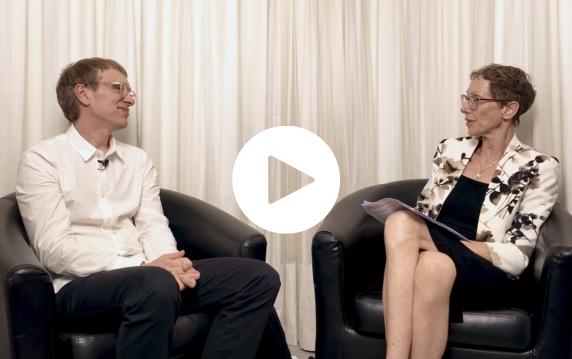
With chronic disease rates climbing in Australia, experts suggest a shift toward patient-centred models, ensuring those with complex needs get the support they deserve.
Hear more in our latest Better, Health, Together video with the Grattan Institute’s Health Program Director, Peter Breadon, who urges a radical shift in how primary care is funded to address the nation’s rising rates of chronic disease.
Read more and watch the full interview in our latest Better Health, Together video.
Nurse Re-entry Program – Strengthen your practice team for 2026

The Nurse Re-entry Program offers a supported way to strengthen your practice team for the year ahead. The program supports general practices to employ nurses re-entering the workforce after 5-10 years away through paid, supervised placements. It also supports nurse practitioners transitioning into general practice.
Eligible practices may receive a grant to support participation. To take advantage of the program, submit the online expression of interest (EOI) form and you will be contacted to discuss your practice’s eligibility and next steps.
For further information, visit the Nurse Re-entry Program webpage or email nursereentry@nbmphn.com.au
Rural Generalist Anaesthesia training program
Rural generalist practitioners with training in anaesthesia play vital roles in providing life-saving services to patients in many rural and remote communities across Australia. The 12-month training program is available to rural generalist registrars and fellows seeking formal training and certification in anaesthesia.
For more information view the flyer here.
Immunisation and cancer screening updates
FluMist – what you need to know

A new needle-free flu vaccination aimed at children is being rolled out across Western Australia in a bid to boost child vaccination rates after the worst flu seasons on record.
Instead of a needle, children from 2 years to 11 years will be able to receive their free influenza vaccine via a nasal spray administered in both nostrils.
How the nasal spray flu vaccine works

The nasal spray flu vaccine works like other nasal sprays. It’s given as a small spray into each nostril and absorbed quickly, so even if you sneeze afterwards, it’ll still work.
Children can have it at the same time as other routine childhood vaccines.
The vaccine could easily be confused with a syringe, adequate signage, and training should be provided.
Further information on FluMist can be accessed via the Flumist provider factsheet.
Information for parents, guardians and caregivers can be accessed via the Flumist consumer factsheet.
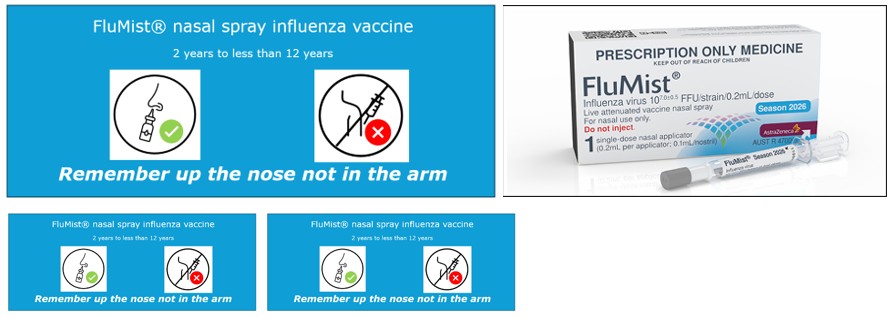
The above labels have been designed to be printed for your fridge and vaccine basket labels.
For a printable version click here.
Staying healthy this winter
Ensuring your patients stay well during the winter months starts now with annual preventative vaccination.
Influenza
After a record number of flu cases in 2025, it is important to ensure everyone eligible has an influenza vaccine.
Remembering that anyone over the age of 6 months is eligible for a free flu vaccine during the months of May and June.
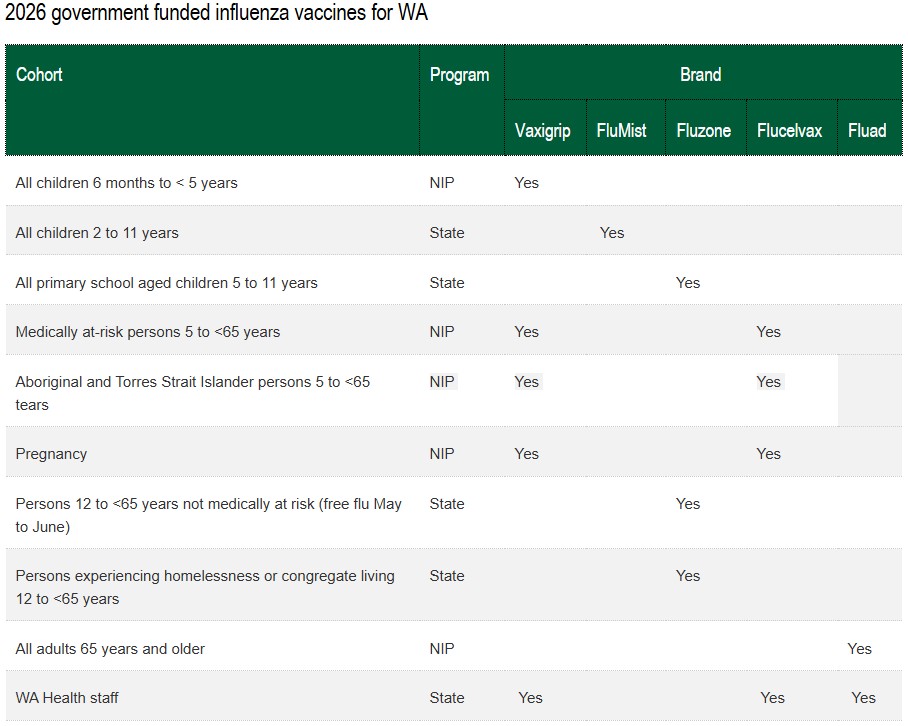
In addition to the vaccination, the Government has released the FluMist intranasal spray for children from 2 years to 11 years as an alternative option.
Respiratory Syncytial Virus (RSV)
The maternal and infant RSV vaccination program has returned for 2026, with the following groups recommended and eligible to be immunised.
- Abrysvo should be offered to all pregnant women year-round, as funded through the National Immunisation Program (NIP).
- Beyfortus should be offered to:
-
- All infants born to mothers who did not receive Abrysvo during the most recent pregnancy.
- All medically at-risk newborns regardless of mum’s Abrysvo vaccination status.
- All Aboriginal or medically at-risk children entering their second RSV season regardless of mum’s Abrysvo vaccination status.
- Any infant born within 14 days of the mother’s receipt of Abrysvo vaccine.
- Any infant born to a mother who had a medical condition or treatment during pregnancy that substantially reduced the level of anti-RSV antibodies available for transplacental to be transferred to the newborn.
- (new recommendation), all infants born between 1 October 2025 and 31 March 2026 irrespective of the mother’s Abrysvo vaccination status, should be offered Beyfortus to boost protection for the winter RSV season.
Additionally, Arexvy is being offered to all adults 65 years and over who reside in a residential aged care home.
COVID-19
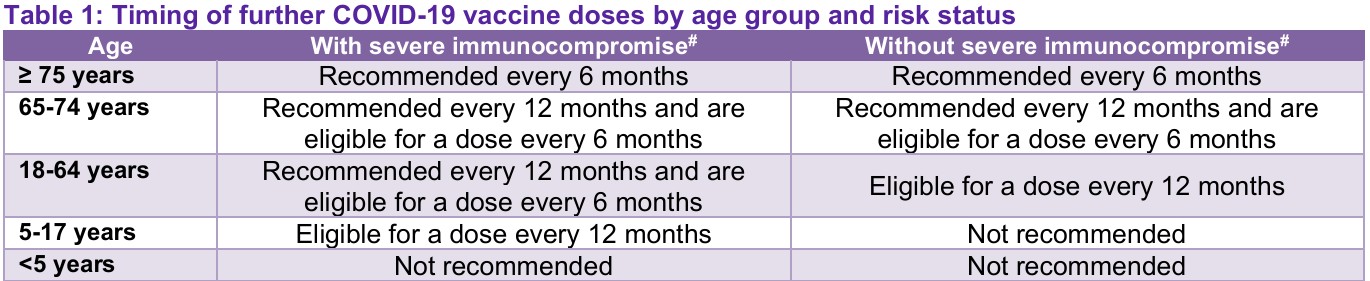
As of today’s date, there has been no changes in the recommendations for COVID-19 immunisations. Our most vulnerable people (older adults) should be having at least an annual immunisation.
Patients 70 years and older (Aboriginal 50 years and older) are also eligible for Pneumococcal vaccination (Prevenar 13/ Pneumovax 23) – previous doses should be checked on the Australian Immunisation Register for eligibility.
Webinar: RSV vaccines and prevention programs – evidence, safety and impact
Presented by National Centre for Immunisation Research and Surveillance
23 April (10am to 11.30am AWST)
Respiratory syncytial virus (RSV) affects people across the lifespan, with infants and older adults experiencing the highest risk of severe disease and hospitalisation.
New vaccines, prevention products and funded programs are now available in Australia, creating important opportunities to reduce RSV illness and its impact.
In this webinar, experts will discuss:
- Disease burden, with a focus on older adults.
- RSV immunisation products, including data on effectiveness, safety and uptake.
- National, state and territory RSV prevention programs.
- Real‑world case studies and tips for discussing RSV vaccination.
- Practical considerations for implementing RSV immunisation, including co‑administration and approaches to minimising errors.
- A live Q&A with experts.
Education and events
Webinar two: Refugee health in primary care
Presented by WA Primary Health Alliance and WA Health
22 April (6pm to 7pm)

Join us for the second webinar in a six-part series about refugee health in primary care, presented in conjunction with WA Health.
This event will provide information about cultural and language considerations and the provision of trauma-informed care.
To find out more, view the flyer and register today.
Webinar: Early detection and management of chronic kidney disease (CKD)
Presented by WA Primary Health Alliance and Kidney Health Australia
23 April (6pm to 7pm)

Join us for the first webinar in this series with Kidney Health Australia.
Guest speaker Professor Mark Thomas will explore the early detection, diagnosis and management of chronic kidney disease (CKD) in at-risk populations.
To find out more, view the flyer and register today.
Preventative Health Forums – Strengthening immunisation and cancer screening in general practice
Presented by WA Primary Health Alliance
6 May and 13 May (6pm to 9pm)

WA Primary Health Alliance invites practice nurses to attend our Preventative Health Forums.
These face-to-face events will provide information about the National Immunisation Program (NIP), vaccine safety and administration, and the national cancer screening programs.
To find out more, view the flyer and register for the Perth South Forum or the Perth East Forum today.
Other Webinars, Events & Workshops
| Living without a spleen: Translating Guidelines into Everyday Care Presented by Spleen Australia 17 April |
| BreastScreen WA mobile visit to Collie Presented by BreastScreen WA 17 April to 9 June |
| BreastScreen WA mobile visit to Kalbarri Presented by BreastScreen WA 21 April |
| BreastScreen WA mobile visit to Broome Presented by BreastScreen WA 21 April to 19 May |
| Suicide Prevention Training Primary Care Support Staff (Online via Teams) Presented by Wesley LifeForce and WA Primary Health Alliance 21 April and 23 April |
| AI in Mental Health Care: Using Digital Phenotyping to Optimise Treatment Timing Presented by Black Dog Institute 22 April |
| BreastScreen WA mobile visit to Northampton Presented by BreastScreen WA 22 April to 1 May |
| National Suicide Prevention Conference Presented by Suicide Prevention Australia 28 April to 30 April |
| Empowering Families to Plan for End of Life Presented by Linkwest 30 April |
| BreastScreen WA mobile visit to Mullewa Presented by BreastScreen WA 4 May to 5 May |
| Advanced Training in Suicide Prevention – Blended Learning Presented by Black Dog Institute 6 May |
| Mental Health First Aid (Broome, Kalgoorlie and Geraldton) Presented by APNA and supported by WAPHA 6 May |
| BreastScreen WA mobile visit to Morawa Presented by BreastScreen WA 6 May to 8 May |
| Rural and remote retrieval weekend Presented by Rural Health West 7 to 10 May |
| BreastScreen WA mobile visit to Three Springs Presented by BreastScreen WA 11 May to 18 May |
| WAEDOCS Symposium 2026 Integrative Care Presented by Government of Western Australia North Metropolitan Health Service 12 May |
| Dealing with Depression in Rural Australia – Blended Presented by Black Dog Institute 18 May |
| BreastScreen WA mobile visit to Port Denison Presented by BreastScreen WA 19 May to 15 June |
| BreastScreen WA mobile visit to South Hedland Presented by BreastScreen WA 21 May to 9 June |
| Sexual Health and BBV Management and Care for Nurses and Midwives Presented by ASHM 2 June, 4 June, 9 June and 11 June |
| Advanced Training in Suicide Prevention – Blended Learning Presented by Black Dog Institute 11 June |
| Talking About Suicide Prevention in Practice – Webinar Presented by Black Dog Institute 20 June |
Acknowledgement
WA Primary Health Alliance acknowledges and pays respect to the Traditional Owners and Elders of this country and recognises the significant importance of their cultural heritage, values and beliefs and how these contribute to the positive health and wellbeing of the whole community.