
Issue 244 – 30 April 2026
|
Welcome to Practice Connect, a fortnightly update for practice managers, principals, nurses and administration staff on relevant issues, upcoming events and education. |
Feature edition – Immunisation
World Immunisation Week

World Immunisation Week, celebrated in the last week of April, aims to promote the life-saving power of immunisation to protect people of all ages against vaccine-preventable diseases.
Vaccines have long been one of the most powerful tools in public health. Over the last 50 years, vaccines have saved more than 150 million lives worldwide, because ordinary people decided to protect themselves, their children and one another.
That’s six lives every minute, every day for five decades.
This year’s World Immunisation Week theme, ‘For every generation, vaccines work’, aims to promote how vaccines have safely protected people, families and communities for generations and continue to safeguard our future.
The World Health Organisation has released some resources that can be added to your current practice resources.
Find them here.
FluMist vaccine free for children

Western Australia has launched the most comprehensive FluMist program in the country, providing free, needle-free influenza vaccines to children aged from 2 years to 11 years.
Eligible children can access FluMist through community health clinics, GPs, Aboriginal medical services and pharmacies across the state.
For detailed information about administering FluMist, please refer to the Australian Immunisation Handbook and the ATAGI Statement on the administration of seasonal influenza vaccines in 2026.
More information for clinicians can also be found in the following resources:
- 2026 WA Influenza Nasal Spray Vaccination Program for Children – Fact Sheet for Providers.
- NCIRS Influenza resources.
Refer your patients to the following digital resources:
- Influenza vaccination for children – Information for WA parents and carers.
- Download the FluMist promotional video series from the WA Department of Health to encourage uptake.
Printable labels for your practice:
Improving influenza immunisation rates in WA children for winter 2026
In 2025, around 25% of influenza notifications were in children aged 2 to 11 years, with more than 17,000 children presenting to emergency departments with respiratory illnesses and over 1,300 admitted to the hospital. Despite the heavy burden of influenza illness in children, only 17% of this age group were vaccinated against influenza in 2025.
As part of the WA Health Winter Strategy 2026, WA children aged from 2 years to 11 years are eligible for a free needle-free nasal spray flu vaccine, FluMist. This initiative aims to improve immunisation rates and reduce the impact of influenza. Our quality improvement (QI) activity for this month gives you a Plan, Do, Study, Act (PDSA) template to track how offering this service affects your influenza vaccination rates in this cohort of patients. If you would like any assistance in running this activity, please contact either your known QI Coach for your region or the team via email at qi@wapha.org.au
QI Activity: Increasing influenza vaccination in 2 to 11 year olds by introducing FluMist nasal spray
Infectious diseases health alert: Diphtheria outbreak in regional WA
An infectious disease health alert for clinicians was released 24 April 2026 by the Communicable Disease Control Directorate (CDCD) regarding the ongoing diphtheria outbreak in regional Western Australia.
The CDCD has provided the following updates:
- There have now been 35 confirmed cases of locally acquired diphtheria reported since the outbreak began in Western Australia in late December 2025, with most cases occurring among Aboriginal people in the Kimberley region.
- This total includes one severe respiratory infection, 11 mild respiratory infections, and 23 cutaneous (skin) infections.
- Vaccination remains the best protection against diphtheria, but multiple doses are required to produce and maintain immunity. Clinicians should ensure that children, adolescents, and adults are up to date with the appropriate DTPa or dTpa vaccination.
- GPs in other regions are reminded to remain vigilant for patients from the Kimberley, Pilbara and Goldfields regions, who may present with clinically suspicious skin sores, infected wounds, or upper respiratory illness.
Please refer to the clinician alert for testing advice and other key information.
The Aboriginal Health Council of WA (AHCWA) has developed flyers to raise awareness of diphtheria among patients.
RSV vaccine funding and access for older Australians

National Immunisation program eligibility:
From 15 May 2026, the respiratory syncytial virus (RSV) vaccine, Arexvy, will be funded through the National Immunisation Program (NIP) for the following groups:
- Adults aged 75 years and over.
- Aboriginal and Torres Strait Islander adults aged 60 years and over.
Access points:
Eligible older adults will be able to receive the free RSV vaccine from GPs, immunisation clinics, community and Aboriginal medical services, as well as participating pharmacies.
WA State Government initiative:
The Western Australian state government will provide Arexvy to people aged 60 and over living in residential aged care facilities. This initiative aims to protect vulnerable seniors by offering greater access to this important vaccine.
Eligibility criteria for additional groups:
Individuals may also be eligible for vaccination if they meet any of the following criteria:
Aged 60 to 74 years and
- Residing in a residential aged care facility,
- Receiving Commonwealth Support at Home*,
- Living in specialist disability accommodation (SDA)**,
- Staying in residential mental health services,
- Experiencing homelessness,
- Incarcerated in a correctional facility.
Aged 50 to 59 years in one of the above settings and
- Are Aboriginal,
- Have a risk factor for severe RSV disease.
Exclusions:
*Excludes persons on the Support at Home waitlist and those on the Commonwealth Home Support Package (CHSP).
**Excludes persons on the SDA waitlist or receiving supported independent living (SIL).
Vaccine ordering process:
Practices will be able to order the vaccine via the usual Onelink process in May. WA Primary Health Alliance will provide additional information as it becomes available.
‘Stick it to the Flu’ resources now available
The Australian Government Department of Health, Disability and Ageing has launched a series of posters and digital resources to help immunisation providers offer people the information they need about influenza vaccination this year.
Designed specifically for parents of children under 5 years of age, adults, expectant mothers and Aboriginal and Torres Strait Islander peoples, the resources provide information on:
- Why and when people should get vaccinated against influenza this year.
- Who is eligible for a free influenza vaccine under the National Immunisation Program?
- Influenza vaccine safety.
Access the resources here.
Childhood influenza vaccination barriers in Australia, 2025 national survey
A new national study shows that people are now choosing not to get vaccinated mainly because of their beliefs and worries about flu vaccines, rather than practical factors like how easy it is to book appointments or vaccination costs. Parents reported that influenza vaccination for their child was not a priority, that they do not intend to vaccinate their child in the next influenza season and that they do not believe the vaccine is effective.
Key messages:
- The top ten most common barriers in 2025 were related to influenza vaccine acceptance.
- The barrier most strongly associated with not vaccinating in 2025 was choosing not to prioritise an influenza vaccination over other things.
- All eleven acceptance barriers and all four access barriers were more commonly reported among parents of unvaccinated children than among parents of vaccinated children in 2025.
- Nine of the eleven acceptance barriers were more commonly reported in 2025 than in 2024, while access barriers remained stable or slightly declined.
The findings signal a shift in beliefs about disease risk and the value of vaccination, despite convincing evidence that influenza can cause serious illness, hospitalisation and, in rare cases death in young children.
These insights reinforce the need to clearly communicate the importance of influenza vaccination, the potential impact of influenza infection, and to integrate it into our routine care.
Find the key findings and summary here.
Immunisation Coalition – 2026 RSV and influenza clinical newsletters
The Immunisation Coalition has released four 15‑minute clinical newsletters (two on RSV and two on influenza) covering disease burden, recent vaccination trends and prevention strategies for infants/children up to 24 months and for children/adolescents aged 6 months up to 18 years.
The RSV newsletters discuss RSV disease, vaccination trends, and preventive approaches for infants and children aged up to 24 months, including maternal RSV vaccination and long-acting monoclonal antibodies. These newsletters also provide eligibility guidance according to national and state or territory recommendations.
The influenza newsletters explore influenza disease, vaccination trends, and prevention strategies for children aged 6 months to up to 18 years, including vaccination recommendations and available vaccines, injectable and intranasal.
To access these resources, register and view the newsletters here.
Cancer screening updates
Promote lung cancer screening in your practice and win!
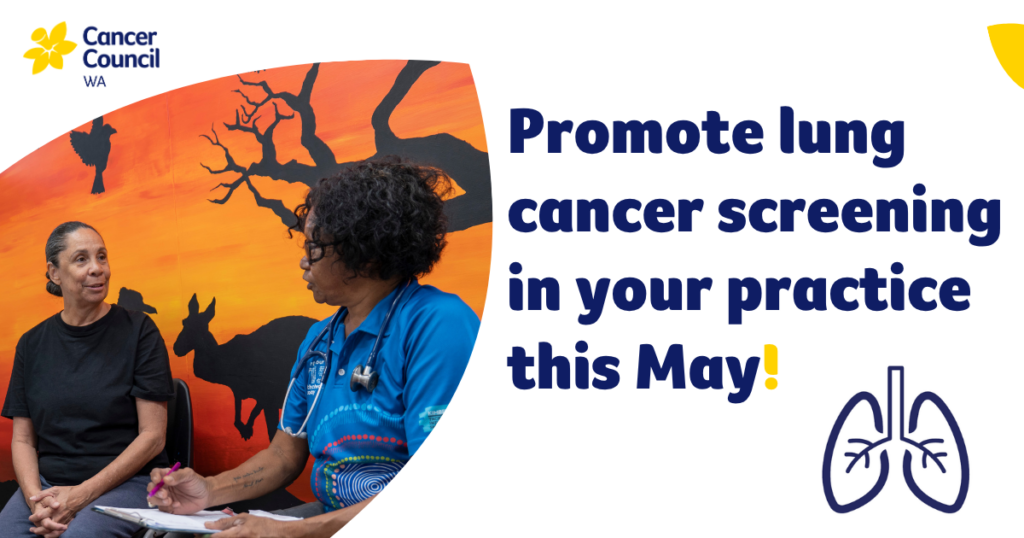
Cancer Council WA, WA Health, and WA Primary Health Alliance invite your practice to help raise awareness of the National Lung Cancer Screening Program (NLCSP) by hosting a waiting room display during May 2026.
By setting up a display in your practice you can help patients understand the importance of lung cancer screening, who is eligible, how it works and why early detection can save lives.
How to get involved:
- Order a free resource pack for your display via our order form.
- Set up your NLCSP display in your waiting room during May 2026.
- Send a photo of your display to gp@cancerwa.asn.au by 15 June 2026 to be entered into the competition.
Win a prize!
- Every practice that submits a photo will receive a $25 gift card.
- The major prize, a $300 gift card, will be awarded to the display judged to be most creative, innovative and reflective of overall effort. The winner will be chosen by WA Health and notified on 17 June by 5:00pm (AWST).
Medicare and MyMedicare updates
MyMedicare Minute from the Department of Health, Disability and Ageing
|
MyMedicare Minute – Week Five One key message. One minute to read. |
|
All patients can receive a GP Chronic Condition Management Plan (GPCCMP) and eligible reviews from their usual GP.
What practices need to know
Resources We encourage you to utilise the Department of Health, Disability and Ageing or Services Australia websites for more information. |
Health promotion event
Heart Week 4-10 May 2026: Never miss a BEAT
About Heart Week
Heart Week is Australia’s national heart health awareness week held in May each year.
This Heart Week, the Heart Foundation is encouraging health professionals to ‘Never miss a BEAT’ by using the latest tools and resources to deliver more Heart Health Checks to eligible patients.
Get involved in Heart Week
Start a conversation with your patients about heart disease and the steps they can take to improve their heart health this Heart Week.
- Get ready for Heart Week.
- Use the Aus CVD Risk calculator.
- Access new clinical education.
- Download practical tools and templates.
Learn more here.
Education and events
Preventative Health Forum – Strengthening immunisation and cancer screening in general practice
Presented by WA Primary Health Alliance
13 May (6pm to 9pm)
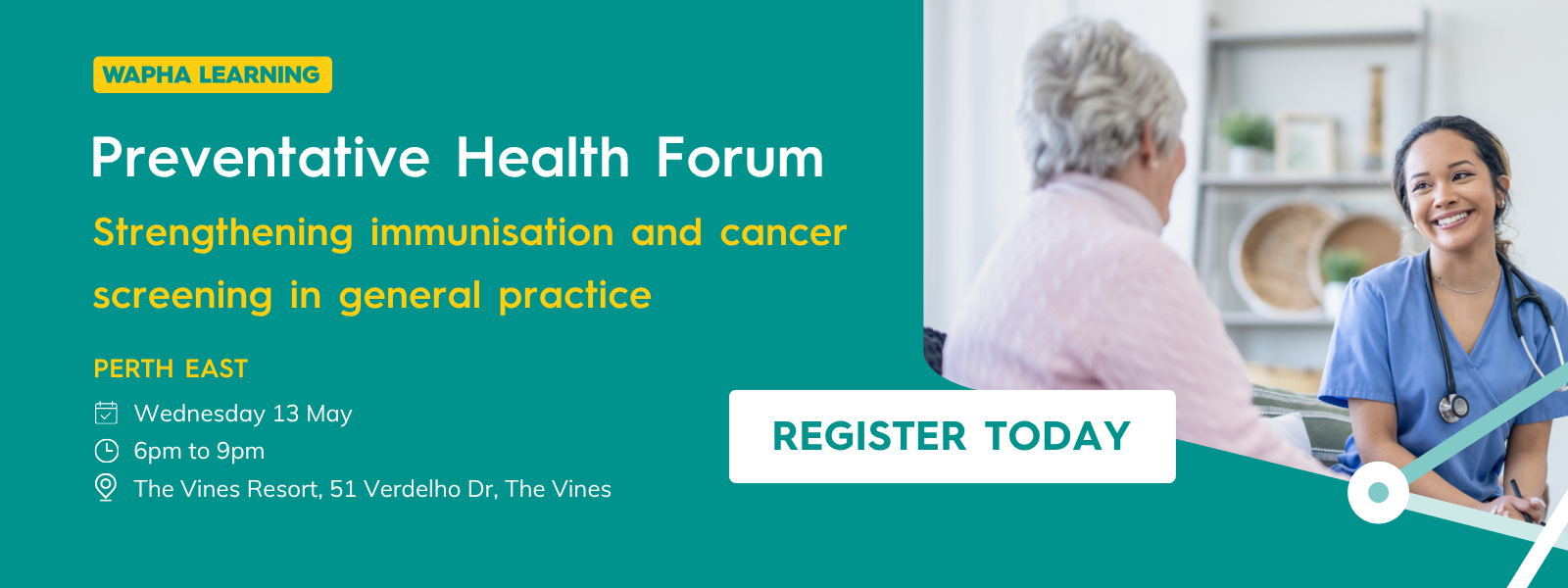
WA Primary Health Alliance invites practice nurses to attend our Preventative Health Forum.
This face-to-face event will provide information about the National Immunisation Program (NIP), vaccine safety and administration, and the national cancer screening programs.
Find out more and register for the Perth East Forum today.
Health assessments made easy: Turning reports into patient results
Presented by WA Primary Health Alliance
3 June (12pm to 1pm)
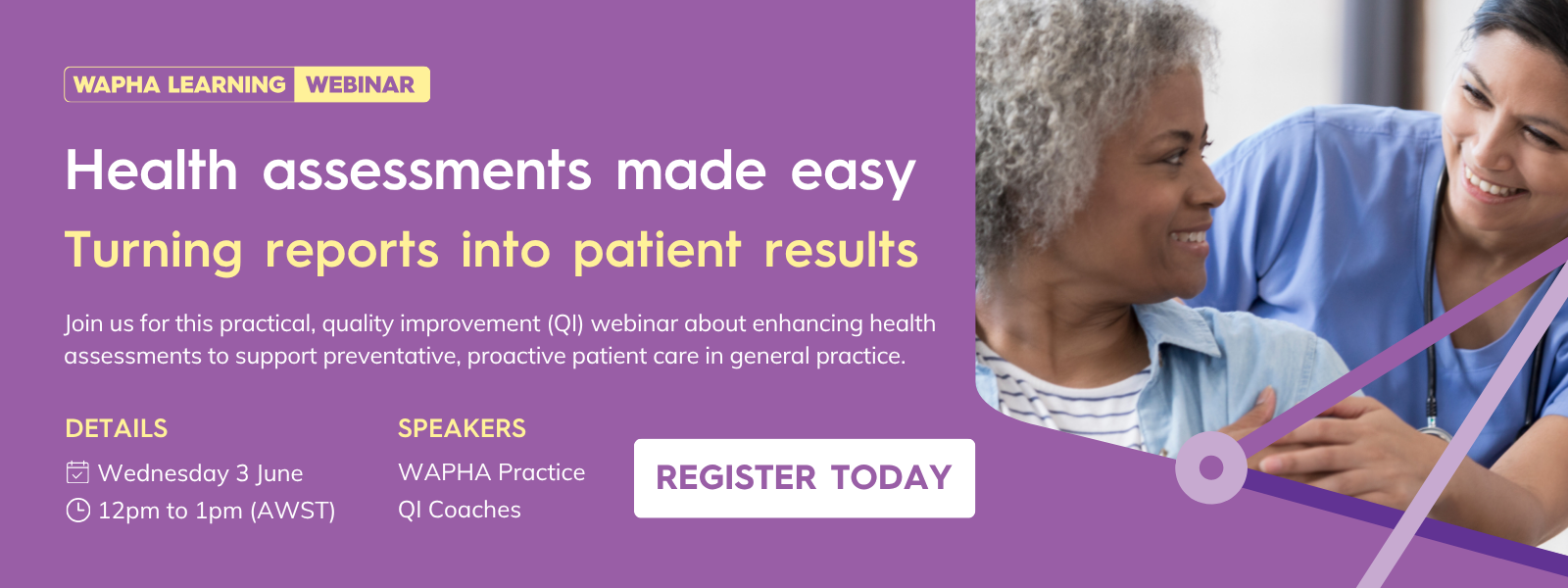
Join us for this practical, quality improvement (QI) webinar that will focus on enhancing health assessments to support preventative, proactive patient care in general practice.
To find out more, view the flyer and register today.
Quality improvement (QI) webinars:
Catch up on previous webinar sessions by visiting the Quality Improvement YouTube series.

View our new QI Bites videos – Primary Sense in Practice:
- Video 2: Health Assessments Report
- Video 3: PIP QI 10 Measures Report
- Video 4: CVD Patients for Screening, Recall and Treatments Report
Other Webinars, Events & Workshops
| BreastScreen WA mobile visit to Mullewa Presented by BreastScreen WA 4 May to 5 May |
| Advanced Training in Suicide Prevention – Blended Learning Presented by Black Dog Institute 6 May |
| Return to Work: Bridging the Communication Gap Presented by Mental Health Professionals Network and Comcare 6 May |
| Mental Health First Aid (Broome, Kalgoorlie and Geraldton) Presented by APNA and supported by WAPHA 6 May |
| BreastScreen WA mobile visit to Morawa Presented by BreastScreen WA 6 May to 8 May |
| Rural and remote retrieval weekend Presented by Rural Health West 7 to 10 May |
| BreastScreen WA mobile visit to Three Springs Presented by BreastScreen WA 11 May to 18 May |
| WAEDOCS Symposium 2026 Integrative Care Presented by the Government of Western Australia, North Metropolitan Health Service 12 May |
| Understanding voluntary assisted dying in practice Presented by the Department of Health End-of-Life Care Program 15 May (session one) and 18 September (session two) |
| Dealing with Depression in Rural Australia – Blended Presented by Black Dog Institute 18 May |
| BreastScreen WA mobile visit to Port Denison Presented by BreastScreen WA 19 May to 15 June |
| The Big 5 – Simple Steps for Better Mental Health (Kalgoorlie) Presented by MindSpot GP, WA Primary Health Alliance and Goldfields Health Professionals Network 20 May |
| BreastScreen WA mobile visit to South Hedland Presented by BreastScreen WA 21 May to 9 June |
| Sexual Health and BBV Management and Care for Nurses and Midwives Presented by ASHM 2 June, 4 June, 9 June and 11 June |
| Advanced Training in Suicide Prevention – Blended Learning Presented by Black Dog Institute 11 June |
| BreastScreen WA mobile visit to Rangeway (Geraldton) Presented by BreastScreen WA 16 June to 18 June |
| BreastScreen WA mobile visit to Geraldton Presented by BreastScreen WA 19 June to 12 January |
| Talking About Suicide Prevention in Practice – Webinar Presented by Black Dog Institute 20 June |
| Aboriginal Health Conference 2026 Presented by Rural Health West 16 August |
Acknowledgement
WA Primary Health Alliance acknowledges and pays respect to the Traditional Owners and Elders of this country and recognises the significant importance of their cultural heritage, values and beliefs and how these contribute to the positive health and wellbeing of the whole community.