
Issue 249 – 9 July 2026
|
Welcome to Practice Connect, a fortnightly update for practice managers, principals, nurses and administration staff on relevant issues, upcoming events and education. |
Feature – Health of Aboriginal people
NAIDOC Week 2026: 50 Years of Deadly

National NAIDOC Week will be held from 5–12 July 2026 with the theme 50 Years of Deadly, celebrating five decades of culture, community leadership, strength and achievement across Aboriginal and Torres Strait Islander communities. Read more on NAIDOC Week’s theme here.
For general practices, NAIDOC Week is an opportunity to recognise the importance of culturally safe, respectful and welcoming care for Aboriginal and Torres Strait Islander patients, families and communities.
How practices can get involved:
General practices can get involved in NAIDOC week by promoting culturally safe practices and raising awareness about Aboriginal health issues:
- Display posters and information about NAIDOC Week in patient waiting areas and share digital assets through your practice communication channels
- Encourage your staff and patients to attend local NAIDOC week events
- Read about WAPHA’s commitment to the health of Aboriginal people in the WA Primary Health Alliance Aboriginal Cultural Competency and Capability Framework
- Take a look at the WA Primary Health Alliance Aboriginal Cultural Competency and Capability Toolkit to explore resources and training on providing a culturally safe environment for your Aboriginal patients
NAIDOC Week resources:
NACCHO Aboriginal and Torres Strait Islander health resources:
Registered cultural awareness and safety training providers:
Other resources:
- Aboriginal Health Council of Western Australia (AHCWA)
- Australian Indigenous HealthInfoNet
- National guide to a preventive health assessment for Aboriginal and Torres Strait Islander people
For further support, information or guidance with Aboriginal Health in your practice, please contact Practice Assist or your Primary Care Navigator on 08 6278 7900 or via email practiceassist@wapha.org.au
Quality improvement activity July 2026 – Health assessments for Aboriginal and Torres Strait Islander people
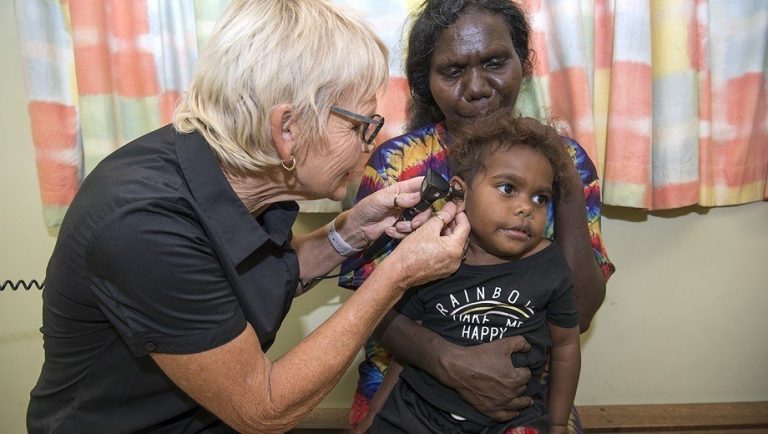
Health assessments are a cornerstone of preventive health care, providing a proactive approach to supporting patient wellbeing and preventing disease.
The Medicare Benefits Schedule (MBS) health assessment aims to support Aboriginal and Torres Strait Islander people to receive primary health care that is matched to their needs by encouraging early detection, diagnosis and intervention for common and treatable conditions that contribute to illness and early mortality.
The Aboriginal Health Assessment, commonly referred to as the 715 Health Check, is a Medicare-funded assessment for Aboriginal and Torres Strait Islander peoples of all ages. This assessment can be done every nine months. It considers physical, psychological and social wellbeing, supporting early detection, disease prevention and access to follow-up care.
From 1 March 2026, age-based clinical activities have been removed and replaced with broader preventive health activities tailored to the individual’s needs and clinical circumstances throughout life. Please see MBS Online notes for full eligibility and requirements.
To support ongoing care, MBS item number 10987 services can be provided by a practice nurse or Aboriginal and Torres Strait Islander health practitioner, on behalf of a medical practitioner, for an Aboriginal and Torres Strait Islander person who has received a health assessment.
A health assessment:
- is meaningful and beneficial for the patient
- identifies health needs, including the patient’s goals and priorities
- supports patients to take an active role in their health and wellbeing
- provides a framework for primary and secondary disease prevention through health advice, risk assessment and other appropriate measures
- is ideally provided by the patient’s regular health care provider
- includes a documented plan for follow-up of identified health needs, priorities and goals
- can provide an opportunity to begin culturally sensitive advance care planning, where appropriate
Getting started with Aboriginal health assessment activities
- Create a culturally safe health care environment for Aboriginal and Torres Strait Islander people
- Increase awareness of available services for Aboriginal and Torres Strait Islander people
- Increase participation in cervical, breast and bowel cancer screening among eligible Aboriginal and Torres Strait Islander people
- Improve the collection and recording of Aboriginal and Torres Strait Islander status
- Use recall and reminder systems to support Aboriginal and Torres Strait Islander patients
Our team of dedicated Quality Improvement Coaches are happy to assist with tailored QI support and development of activities for your practice. If you would like a QI Coach to support your team, contact us via our email qi@wapha.org.au
MyMedicare and Medicare updates
Assignment of Benefit changes from 1 July 2026

From 1 July 2026, updated Assignment of Benefit (AoB) requirements apply to all Medicare bulk billed services.
What is Assignment of Benefit?
When a patient is bulk billed, they agree to assign their Medicare benefit to the provider as full payment for the service.
The provider then claims the benefit directly from Medicare and the patient has no out-of-pocket cost for the bulk billed service.
What is changing?
The updated requirements focus on how consent is obtained, recorded and stored.
Practices should review their current workflows and confirm their software, forms and team processes support the new requirements.
Key updates include:
- Patient agreement is required. Patients must be given enough information to understand what they are agreeing to when assigning their Medicare benefit for a bulk billed service. If a patient does not agree to assign their Medicare benefit, the service cannot be claimed as bulk billed and alternative billing arrangements must be discussed before a claim is submitted
- Pre or post service assignment options: consent can be obtained before or after the service, including through digital workflows
- No mandatory form: practices can use paper or electronic formats, provided the agreement captures the required information
- Updated signature requirements: patients, or an appropriate assignor, must provide consent. Practitioner signatures are no longer required
- New assignment pathways: this includes pre-service assignment and enduring assignment for eligible patients, such as MyMedicare-registered patients of Aboriginal medical services and residential aged care home patients
- Transition arrangements: a 12-month transition period applies from 1 July 2026, including continued support for verbal assignment while systems adapt
- Record keeping: practices must retain AoB agreements for two years from the date the claim is made, including records of verbal consent
Telehealth transition:
Verbal consent remains available during the 12-month transition period from 1 July 2026, including for telehealth services. Practices must still keep a compliant AoB record and should move towards documented consent processes as systems and workflows are updated.
Enduring Assignment of Benefit:
From 1 July 2026, eligible patients may be able to provide ongoing consent for future bulk billed GP services, rather than completing a new assignment each time they attend.
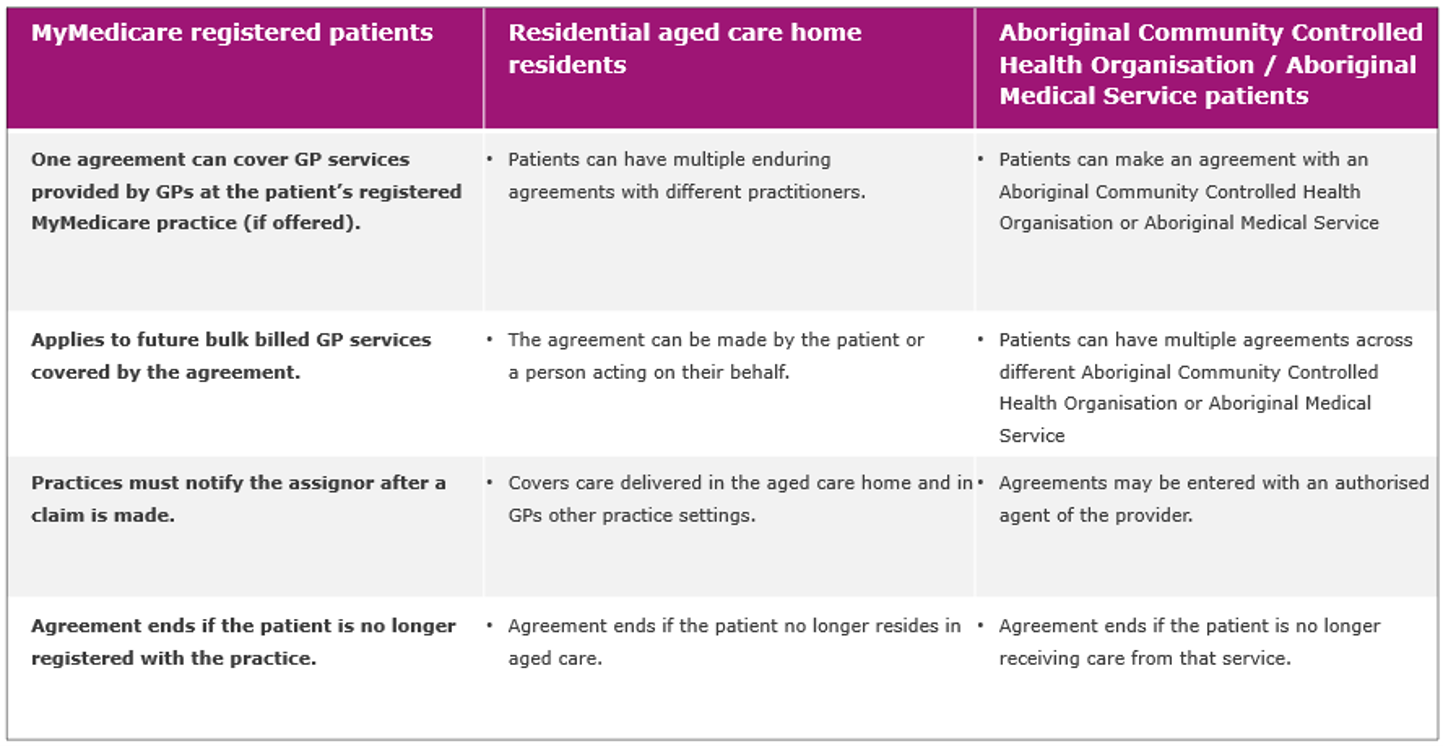
Enduring agreements must:
- Relate to ongoing GP services
- Include patient, or assignor, consent and signature
- Include the required information set out in legislation
- Be able to be ended at any time by either the patient or the practice
- Remain valid until circumstances change, such as the patient leaving the practice or care setting
- Replace the need to capture consent at each visit for services covered by the agreement.
What practices can do now:
- Review current bulk billing and AoB workflows, including telehealth and off-site services
- Confirm practice management software and digital consent processes are ready for the updated requirements
- Ensure reception, nursing and clinical teams understand when and how consent should be captured.
- Check that AoB agreements can be stored and retrieved for at least two years
- Review the Department of Health, Disability and Ageing (DHDA) and Services Australia guidance for the latest templates for episodic and enduring Assignment of Benefit
Resources:
- Assignment of benefit for bulk bill claims – Services Australia
- Assignment of Medicare Benefits for Bulk Billing – Frequently Asked Questions – DHDA
- Improving the assignment of benefit process – DHDA
- Update to Assignment of Medicare Benefit requirements – Bulk billing – Templates for episodic and enduring Assignment of Benefit
- Update to Assignment of Medicare Benefit requirements – Simplified billing
- RACGP Webinar 14 July 2026 – New assignment of benefit (AoB) processes commence for Medicare bulk billed services
For enquiries or further details regarding the Assignment of Benefit (AoB), please reach out to AssignmentofBenefit@health.gov.au
For further support to find information, establish efficient workflows or guidance on patient communication, please contact Practice Assist or your Primary Care Navigator on 08 6278 7900 or via email practiceassist@wapha.org.au
Medicare Mental Health eReferral
The Medicare Mental Health eReferral provides a secure, electronic way for GP and non-GP referrers to submit referrals directly into the Medicare Mental Health intake system. It reduces reliance on email or fax referrals and supports more complete, consistent referral information.
Why was it created?
- To simplify the referral process for referrers
- To reduce incomplete referrals and follow-up
- To support faster triage and access to services
- To provide a consistent, standardised referral pathway across regions
- To close the referral loop, allowing referrers to receive confirmation and track referral status in real time
How to access?
- GPs can refer using the HealthLink SmartForm within their clinical software
- Online eReferral webforms for non-GP referrers and services that do not use HealthLink are also available, using region specific links below:
-
- Country WA – online eReferral webform
- Perth North – online eReferral webform
- Perth South – online eReferral webform
Watch a demonstration video that guides you through the referral process in HealthLink. Unsure of your Primary Health Network? Access the PHN locator.
While no referral is needed for a person to access Medicare Mental Health, referrals are welcomed from GPs, primary health care professionals, local hospital and health service providers and non-government organisations.
For support related to the HealthLink SmartForm, contact 1800 125 036 or HelpdeskHL@healthlink.net
Medicare Mental Health Check In providing free online mental health support
Medicare Mental Health Check In provides free, confidential and accessible online mental health support. It is for people aged 16 years and over who live in Australia. No referral or diagnosis is needed.
The online service offers early support, before mental health challenges escalate, through evidence-based low-intensity Cognitive Behavioural Therapy.
People can choose between working through the online tools on their own or with the support of a qualified mental health practitioner:
- Self‑guided support allows people to work through the tools independently, anytime and anywhere, at their own pace
- Guided support allows people to work through the tools with a qualified mental health practitioner via telehealth. Guided support is delivered over several sessions
- Each program takes around 6 weeks to complete
How to access:
- Clients can call the Medicare Mental Health phone service on 1800 595 212 or request a callback, or visit a Medicare Mental Health Centre to be referred. Speaking with Medicare Mental Health will help decide whether an online program is right for the client, and if so, how to access and start the program. If this service isn’t the right fit, they will connect clients to a more suitable service
- GPs and non-GP referrers can submit a Medicare Mental Health ereferral
Find out more about Medicare Mental Health Check In.
Watch the video here:
MyMedicare Minute from the Department of Health, Disability and Ageing
|
MyMedicare Minute One key message. One minute to read. |
MyMedicare strengthens continuity of care with a patient’s regular practice, while still allowing patients to attend any practice for care when needed.
What practices need to know
Resources We encourage you to utilise the Department of Health, Disability and Ageing or Services Australia websites for more information. |
Practice news
New Clinician Assist WA resource pages now available

Clinician Assist WA is a secure website and clinical support tool which provides GPs and health professionals with clear, locally accepted guidance for assessing, managing and referring patients across Western Australia.
Resource pages give users access to high-quality, reputable and locally relevant resources, in one place, saving users time searching for and scrutinising the reliability of information found elsewhere.
The first two resource pages are now available:
Visit the Clinician Assist WA website to view these new pages and access a wide range of other relevant resources designed to support your clinical practice.
My Health Record changes: an important update for general practices
Recent changes to My Health Record legislation may mean your practice needs to review its security and access policy. The My Health Records Rules 2026 came into effect on 1 April 2026, replacing the 2016 Rules.
If your practice registered:
- Before 1 April 2026, you have until 1 October 2026 to update your policy
- Practices registering from 1 April 2026 need to have a compliant policy in place as part of registration
What this means for your practice:
The updated Rules place a stronger focus on how practices manage user access, staff training, security processes and My Health Record data breach requirements. They also ask practices to keep records that show how their policy is being followed.
What to do next:
A helpful first step is to check whether your current policy reflects the 2026 Rules. You may also wish to review how staff access is managed, how training is recorded, and how your practice would respond to any security concerns.
Refer to these supporting resources to ensure your policy is up to date and meets the new requirements:
- Organisation Registration Checklist
- Participation obligations
- The Security and Access Policy requirements
- ADHA recommended training list fact sheet
If you would like support on the changes or to work through your practice processes, contact Practice Assist on 08 6278 7900 or email practiceassist@wapha.org.au
Immunisation and cancer screening updates
Expansion of diphtheria immunisation response

Immunisation providers should have received an email from the WA Department of Health updating the current advice and expansion of the diphtheria immunisation program in response to the recent outbreak in areas of the Kimberley, Pilbara and Goldfields.
Diphtheria-containing vaccines are already free of charge across WA under the National Immunisation Program for the following groups:
- Infancy and early childhood: at 6 weeks, 4 months and 6 months, 18 months and 4 years
- Adolescents: in Year 7 of school, typically between 12 and 13 years
- Pregnancy: ideally between 20- and 32-weeks’ gestation of each pregnancy
- Refugees and humanitarian entrants: who have not previously received diphtheria-containing vaccines
These vaccines should continue to be used for all individuals eligible under the National Immunisation Program who are due for a scheduled dose.
In response to the outbreak in regional WA, the WA Immunisation Schedule and WA Aboriginal Immunisation Schedule have been updated to include eligibility for outbreak-funded vaccine boosters for the following individuals who have not received a diphtheria-containing vaccine in the past 5 years and who are not currently due a dose under the National Immunisation Program:
-
- Aboriginal people residing in WA
- Non-Aboriginal people residing in the Kimberley, Pilbara, Goldfields or Midwest regions
- People with regular face-to-face contact with Aboriginal communities in the Kimberley, Pilbara, Goldfields or Midwest (e.g. patient-facing healthcare or frontline workers who work, but may not reside, in these regions)
Access the immunisation provider letter here.
Access updated ordering advice here.
If you did not receive this notification through your Onelink ordering account, please ensure all details in your Onelink account are correct.
Changes to pneumococcal vaccination for adults
From 1 July 2026, the 21-valent pneumococcal conjugate vaccine (21vPCV) Capvaxive replaced Prevenar 13 and Pneumovax 23 on the National Immunisation Program (NIP) for adults.
Adults who have previously received a dose of any pneumococcal vaccine (including 23vPPV, 13vPCV, 15vPCV or 20vPCV) are recommended to receive the dose of 21vPCV at least 12 months after their last dose.
The 21vPCV vaccine is now recommended and free for:
- Adults aged 65 years and over
- Aboriginal and Torres Strait Islander adults aged 25 years and over
- Adults aged 18 years and over who have specified medical conditions that increase their risk of severe disease
Please dispose of any remaining Prevenar 13 and/or Pneumovax 23 that you may still have in your fridge and record as wastage.
The Department of Health, Ageing and Disability’s adult pneumococcal vaccination advice for health professionals provides further details.
Updates to the NIP schedule and pneumococcal disease chapter of the Australian Immunisation Handbook also reflect the changes.
Expansion of free access to FluMist to older children
The Western Australian Government has expanded free access to the live attenuated influenza vaccine (LAIV) FluMist to include children aged 12 to 17 years.
The move aims to maximise vaccination opportunities before WA’s free influenza vaccine program concludes on 31 July 2026. Providers are encouraged to prioritise vaccination ahead of this date.
The expansion builds on the state’s existing program, which offers free influenza vaccination for cohorts not eligible for a NIP-funded dose, including an injectable vaccine for those aged 12 to less than 64 years who are not medically at risk or who are experiencing homelessness or congregate living.
Read the Minister’s statement here.
Health professional immunisation kits and campaigns

The Australian Department of Health, Disability and Ageing has released information to support people, parents, carers, and expecting parents in their decisions to keep up to date with their vaccinations.
The free vaccines available through the National Immunisation Program (NIP) are a simple, safe, and effective way to protect children and adults from preventable diseases, such as Influenza, respiratory syncytial virus (RSV), measles and whooping cough.
The Child immunisation information kit for health professionals and RSV maternal vaccination campaign include a range of resources about winter vaccinations, maternal and childhood vaccinations that are suitable for sharing with expecting parents, carers and parents of young children.
The Winter vaccinations information kit for health professionals includes newsletter articles, social media content and links to downloadable resources that provide reminders and information about the importance of vaccination.
For more information and resources visit:
Gaps in parents’ knowledge about influenza vaccines
New findings from the latest National Child Health Poll, show significant gaps in parents’ knowledge about childhood influenza vaccines. More than one-third (37%) of parents across Australia, who were surveyed from 23 April to 5 May 2026, did not know influenza vaccination is recommended for children from 6 months of age, and 43% incorrectly believed that children can get influenza from the vaccine.
Children’s fear of needles is also a barrier to vaccination, with 38% of surveyed parents reporting that it makes influenza vaccination difficult. Many participants (83%) were unaware that a needle-free live attenuated influenza vaccine (LAIV) option is now available for children. More than a quarter (29%) said that they would be more likely to vaccinate their child if they could access the intranasal vaccine.
Clinicians are advised to recommend influenza vaccination to patients, and ensure parents are aware that a needle-free alternative vaccine is freely available for children in WA aged 2 to 17 years.
To support clearer conversations with families, the National Centre for Immunisation Research and Surveillance (NCIRS) has published a comparison guide to help providers answer parents’ questions about the differences between injected and needle-free influenza vaccines.
New dashboards to deliver insights into immunisation coverage in Australia
The Australian Government Department of Health Disability and Ageing has launched a set of new self-service immunisation dashboards that allow easier access to vaccination data from the Australian Immunisation Register.
The dashboards cover four key areas, giving users a comprehensive view of vaccination coverage across the life span:
- Childhood immunisation
- Adolescent immunisation
- Older Australians immunisation
- Respiratory immunisation
Designed to support evidence-based decision making, the dashboards provide information on doses administered, people vaccinated and coverage for vaccine preventable diseases.
Users can explore the data through a range of filters, including geography, age, Aboriginal and Torres Strait Islander status, provider type and gender.
Supporting resources, including a User Guide and Methodology Guide, also provide practical instructions and transparency on how dashboard metrics are calculated and reported.
Explore the dashboards here.
Research and surveys
Immunisation survey (general practice)
WA Primary Health Alliance (WAPHA) would like to better understand how vaccinations are delivered in general practice, for both children and adults.
Your responses will help us to understand what works well in everyday practice, identify common challenges to delivering vaccinations, identify practical supports that could improve vaccination coverage and tailor support from WAPHA to your practice.
The survey will take around 10-15 minutes to complete and closes 24 July 2026 (COB).
Access the survey: Immunisation survey (general practice)
For more information, please contact immunisation@wapha.org.au
Support the MIND-MAP Study – improving mental health in diabetes care
General practices are invited to support the Mental Health IN Diabetes – Monitoring And Pathways (MIND‑MAP) study, a major national research initiative led by the Australian Centre for Behavioural Research in Diabetes. This longitudinal study aims to better understand the emotional wellbeing, resilience and mental health support needs of people living with diabetes, with a target of recruiting 8,000 participants across Australia.
Findings from MIND‑MAP will help inform future models of person‑centred diabetes and mental health care, including the development of dedicated support pathways and resources.
Providers can support the study with minimal effort by displaying participant flyers in waiting areas or making them available to patients. Participation involves four short online surveys over 36 months.
Promotion will align with Diabetes Week (12–18 July). Your support will help strengthen the evidence base and improve outcomes for people living with diabetes and their families.
Education and events
Webinar 4: Common conditions and case studies in refugee health
Presented by WA Primary Health Alliance and WA Health
21 July (6pm to 7pm)

Join us for the fourth webinar in this six-part series, presented in conjunction with WA Health.
This webinar will provide an insight into refugee health checks and managing common conditions, mental health, chronic conditions, disability and women’s health issues, as well as local referral pathways.
To find out more, view the flyer and register today.
Designated Registered Nurse Prescribing Webinars
Presented by WA Health and WA Primary Health Alliance
Metro Webinar: 22 July (6pm to 7pm) and Country Webinar: 23 July (6pm to 7pm)

WA Health and WA Primary Health Alliance invite GPs, general practice staff and other interested primary health care professionals to learn more about the Nursing and Midwifery Board of Australia’s designated registered nurse (RN) prescribing endorsement and application in primary care settings.
To support meaningful and evidence-based Q&A, we invite you to submit questions when registering.
Given the evolving nature of this new endorsement, these webinars will not address operational matters relating to MBS billing, remuneration implications associated with additional qualifications or specific clinical governance issues.
To find out more, view the flyer and register for the Metro Webinar or the Country Webinar today.
Practice Manager Virtual Networking – August
Presented by WA Primary Health Alliance
6 August (11am to 12pm)

Join us at our fourth Practice Manager Virtual Networking Session, which will provide an opportunity for you to connect, discuss topics of interest, share information and raise questions with your WA Primary Health Alliance (WAPHA) support team and other local general practices. These sessions will be held every two months.
When you register for each virtual session, you can indicate which topics you would like to be discussed by using the free text box.
To make the most of these interactive virtual sessions, you will need to have access to a microphone and camera, if possible.
To find out more, view the flyer and register today.
Other Webinars, Events & Workshops
| BreastScreen WA mobile visit to Jurien Bay Presented by BreastScreen WA 9 July to 3 August |
| Ask Us Anything Series – Hepatitis B Edition Presented by ASHM 14 July |
| MPA-MIA Community Webinar Series Presented by Melanoma Patients Australia (MPA) and Melanoma Institute Australia (MIA) 14 July, 21 July and 28 July |
| Integrating Digital Resources into Mental Health Care Presented by Black Dog Institute 15 July |
| BreastScreen WA mobile visit to Lake Grace Presented by BreastScreen WA 21 July to 27 July |
| RSV vaccination for older people Presented by Benchmarque Group 22 July and 23 July |
| Beyond the C National Webinar – Hepatitis C in Primary Care Presented by ASHM 28 July |
| BreastScreen WA mobile visit to Dumbleyung Presented by BreastScreen WA 28 July to 30 July |
| Chronic Conditions and Loneliness Course Presented by eCentreClinic 29 July to 23 November |
| Impact Cafe: Seniors Support Sector Presented by Western Australian Community Impact Hub 3 August |
| BreastScreen WA mobile visit to Wongin Hills Presented by BreastScreen WA 4 August to 14 August |
| Intro to CBT for Health Professionals Presented by Black Dog Institute 8 August |
| BreastScreen WA mobile visit to Cottesloe Presented by BreastScreen WA 10 August to 21 August |
| FDV safety planner webinar Presented by Women’s and Newborn Health Service 12 August |
| Australasian Viral Hepatitis Conference Presented by Hepatitis WA 12 to 14 August |
| WA Hepatitis B Advanced Management and Prescribing Presented by ASHM 15 August |
| Aboriginal Health Conference 2026 Presented by Rural Health West 16 August |
| BreastScreen WA mobile visit to Claremont Presented by BreastScreen WA 24 August to 4 September |
| Course in Ear Wax Removal (Microsuction) Presented by Benchmarque Group 10 September |
Acknowledgement
WA Primary Health Alliance acknowledges and pays respect to the Traditional Owners and Elders of this country and recognises the significant importance of their cultural heritage, values and beliefs and how these contribute to the positive health and wellbeing of the whole community.