
Issue 251 – 6 August 2026
|
Welcome to Practice Connect, a fortnightly update for practice managers, principals, nurses and administration staff on relevant issues, upcoming events and education. |
MyMedicare and Medicare updates
Medicare Benefits Schedule (MBS)

From 1 July 2026, updates to the Medicare Benefits Schedule (MBS) came into effect. These include a 2.6% annual fee indexation for most general medical services, transitional arrangements for updated assignment of benefit requirements for bulk billing, and several new and amended general medical service items.
Information on specific item changes along with the downloadable MBS files can be found on the MBS July News 2026 webpage.
Useful links
- MBS quick guide (July 2026)
- Telehealth MBS items quick guide (July 2026)
- MBS download files
- MBS item number and keyword search
- Printable reference tables and scenarios for Bulk Billing item numbers in General Practice
Updated Assignment of Benefit consent requirements apply to both bulk billing and simplified billing. Consent may be captured digitally or on paper, either before or after the service is provided, and practices must retain a record of the patient’s agreement.
Assignment of Benefit useful links
- Improving the assignment of benefit process
- Assignment of Benefit FAQs
- Assignment of Benefit templates
For a comprehensive explanation of MBS item numbers and claiming requirements, visit MBS Online. Practices can also contact the AskMBS advice service for written responses to MBS item number enquiries by emailing askmbs@health.gov.au
For further support, information or guidance, please contact Practice Assist or your Primary Care Navigator on 08 6278 7900 or via email practiceassist@wapha.org.au
Updated eating disorder treatment and management plans eLearning resources
Learn more about eating disorder treatment and management plans (EDTMP) including:
- EDTMP preparation and review services
- The eligible conditions and patient eligibility criteria
- Treatment services available under an EDTMP
- Referral requirements for eating disorder psychological treatment and dietetic treatment services
- Mental health case conference (MHCC) requirements
The Services Australia Health Professional Education Resources website has a broad range of education resources to help you stay up to date.
To access the EDTMP eLearning resources go to the MBS Mental Health page.
Feedback can be provided on these resources by contacting the Services Australia Health Professional Education team at: HP.EDUCATION@servicesaustralia.gov.au
For further support on MBS please contact Practice Assist or your Primary Care Navigator on 08 6278 7900 or via email practiceassist@wapha.org.au
MyMedicare Minute from the Department of Health, Disability and Ageing
|
MyMedicare Minute One key message. One minute to read. |
Health Professional Education (HPE) resources available
What practices need to know:
Resources: HPOS, Organisation Register and MyMedicare support – step-by-step guidance, videos and training are available through the Services Australia Health Professional Education (HPE) portal. |
Feature – Cancer Screening
National lung cancer screening waiting room competition winners
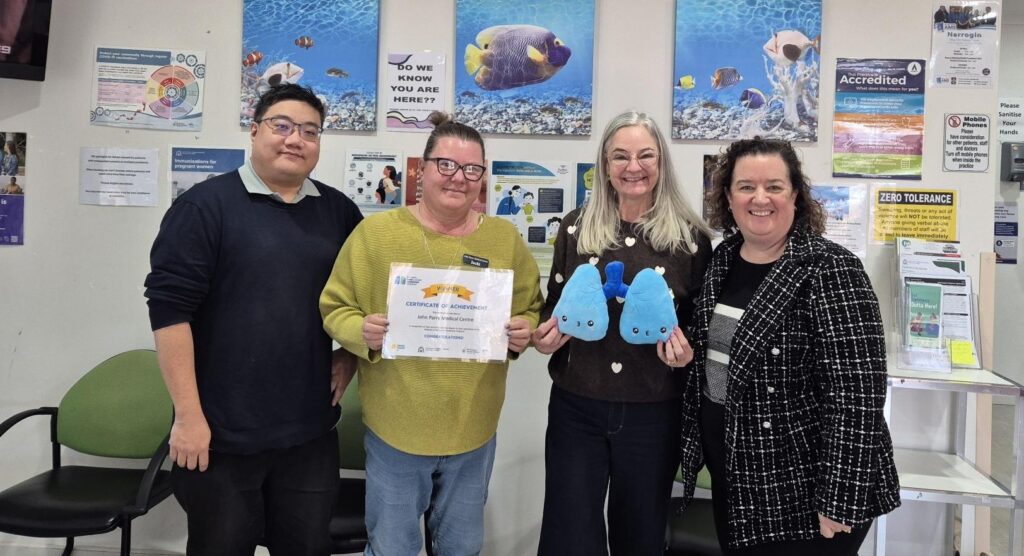
Presentation of winning finalist award to John Parry Medical Centre: Photo left to right Timothy Chan (WAPHA: Quality Improvement Coach), Jacki Gumprich (John Parry Medical Centre: Office Manager), ElMarie Van Wyk (John Parry Medical Centre: Nurse) and Jodie Robins (WAPHA: Program Coordinator – Preventative Health)
During May 2026, 85 practices across WA set up waiting room displays for the National Lung Cancer Screening Program (NLCSP) as part of a competition run collaboratively by Cancer Council WA, WA Department of Health and WA Primary Health Alliance (WAPHA).
Of the participating practices 38 were located in regional WA, with every region across the state represented. The South West had the highest number of entries with 14 practices taking part.
Winner: John Parry Medical Centre in Narrogin, was recognised for its creative and colourful display, which aligned with the NLCSP’s “It’s Good to Know” campaign and Lung Health Awareness Month.
Joint runners-up: Geographe Bay General Practice in Busselton was recognised for a display that included a children’s activity and a clear call to action. Dalwallinu Medical Centre was recognised for its handmade lung display. Due to the high standard of entries, a second runner-up prize was awarded.
With the NLCSP marking its first anniversary on 1 July 2026, the competition provided a timely opportunity to acknowledge the contribution of participating practices. View all entries and read the full story here.
National cancer screening programs

Cancer affects many Australians and can have a significant impact on individuals, families and communities.
The Australian Government Department of Health, Disability and Ageing currently supports four national screening programs to assist with early detection and improve health outcomes:
- BreastScreen Australia Program
- National Bowel Cancer Screening Program
- National Cervical Screening Program
- National Lung Cancer Screening Program
Some cancers can be detected before symptoms develop. As cancer may take many years to develop, screening can identify cancer at an early stage. It can also detect cellular changes before they become cancerous or identify infections that may increase the risk of cancer in the future.
Early detection of cancer can improve the likelihood of effective treatment and survival.
Regular screening remains important, as no screening test is completely accurate and an individual’s health can change over time.
National Lung Screening Program

The National Lung Cancer Screening Program (NLCSP) is a screening program using low-dose computed tomography (low-dose CT) scans to look for lung cancer in high-risk people without any symptoms. It aims to find lung cancer early and save lives.
People are eligible for the program if they are aged between 50 and 70 years and:
- Show no signs or symptoms suggesting they may have lung cancer
- Currently smoke or have quit smoking in the past 10 years
- Have a history of tobacco cigarette smoking of at least 30 pack-years.
Find more information on Delivering the NLCSP.
Quality improvement activities in cancer screening
The cancer screening programs can make excellent quality improvement (QI) activities for your practice.
QI activities highlight the eligible people who are due for screening and give you the framework for recalling and acting on the eligibility data.
WA Primary Health Alliance (WAPHA) and Cancer Council WA have collaborated to create a quality improvement cycle process utilising Primary Sense data. The QI activity is accredited for 6 CPD hours. More information and registration can be found here.
Primary Sense has reports available for immediate download for all cancer screening programs, further information available here.
For further information about undertaking QI activities, contact Practice Assist on 08 6278 7900 or by email at practiceassist@wapha.org.au to connect with one of our Practice QI Coaches.
Practice news
Request for Proposal: Congenital Syphilis Prevention Program – Perth South PHN
The Congenital Syphilis Prevention Program aims to build evidence from models of antenatal care that increase syphilis testing and care in pregnancy to inform the ongoing national syphilis response.
WA Primary Health Alliance (WAPHA) will commission existing community based antenatal care service provider/s to trial innovative or new models of care. These models of care should expand and enhance access to antenatal care that includes syphilis testing and treatment (including for partners) so that syphilis infections are diagnosed and treated, and syphilis is not passed on to the baby. The target cohort for the service is pregnant individuals who are experiencing complex social factors, have barriers to accessing care and/or who are at risk of not receiving antenatal care.
Launch of Metropolitan General Practice Community Residency Program
The General Practice Community Residency Program (GP-CRP) is a pilot funded through the Australian Primary Care Prevocational Program (APCPP) – Metro and delivered by the WA Department of Health. The program will provide WA Health-employed Resident Medical Officers (RMOs) with supervised placements in general practice and primary care settings throughout 2027.
Royal Australian College of General Practitioners (RACGP) Western Australia is currently seeking Expressions of Interest (EOIs) from accredited metropolitan practices and Aboriginal Medical Service (AMS) organisations interested in hosting RMOs as part of the pilot.
Key details include:
- Three metropolitan (MMM1) training sites to participate in the pilot program
- Five RMO rotations of 10–12 weeks during 2027
- Participating practices will receive funding to support supervision and training activities
- The GP-CRP provides an opportunity for practices to contribute to the development of the future GP workforce, while giving junior doctors valuable exposure to primary care and community-based medicine
- EOIs close at 5.00pm AWST on Friday, 21 August 2026
The EOI can be accessed here.
Contact details: Depending on your query, please contact: GP-CRP program: medicalworkforce@health.wa.gov.au
EOI process: WA.Faculty@racgp.org.au
Accreditation process, including supervision or the PGY2 requirements: PMCWA@health.wa.gov.au
GP ASK connects GPs with timely hospital specialist clinical advice
West Australian (WA) general practitioners (GPs) can now access specialist advice through the new GP ASK pilot service provided by WA Health.
GPs need to be registered to access the specialist advice. Please encourage your GPs to register here.
Available specialities
- Respiratory Medicine
- Cardiology
Coming in August 2026
- General Paediatrics
Benefits of GP ASK
- Fast access to advice provided by a WA hospital specialist
- Care closer to home for regional patients
- May reduce the need for a referral to hospital
- May avoid waiting to be seen in hospital
- Two options to receive advice:
- Written advice within five business days
- Virtual Case Discussions (VCD) can be scheduled online between the GP and hospital specialist, with the option of including the patient
- Advice will be returned via HealthLink or eFax and can then be added to a patient’s medical records within practice management software
How GP ASK works
- Submit
Submit a secure online advice request form in the GP ASK platform. If required, schedule a VCD between GP and hospital specialist, with the option of including the patient.
- Review
A hospital specialist reviews your clinical query and, if scheduled, undertakes the VCD.
- Receive advice
Receive a written Clinical Advice Summary (CAS) within five working days of either making a written advice request or following a VCD.
- Manage
Use the advice provided in the CAS to support patient care.
For more information regarding the service, view the GP ASK FAQs.
To arrange a visit to your practice so that GPs can learn more about the service and hear from participating hospital specialists, contact the team at doh.gpask@health.wa.gov.au
Digital health tools: Patient promotional materials for general practice

General practices can access a range of patient-facing promotional materials to support digital health awareness in waiting rooms, including fact sheets, tri-fold brochures, guides and posters.
Resources are available on the following topics:
Better Faster Access
These resources outline recent changes to consumer access to pathology and diagnostic imaging reports through My Health Record and the 1800MEDICARE app. They also provide information about further mandatory sharing by default requirements that commenced in July 2026, which require previously non-participating pathology and diagnostic imaging providers to upload reports to My Health Record, subject to some exceptions.
These changes are intended to support patients and healthcare teams to make more informed decisions about care.
Electronic Prescribing
Electronic prescribing provides a convenient alternative to paper prescriptions. Resources cover topics such as:
- How patients can choose to receive prescriptions electronically, including through electronic prescriptions or Active Script Lists (ASL).
- What happens if I lose my electronic prescription?
- What is an ASL?
- How do I set up an ASL?
My Health Record
My Health Record is Australia’s secure, national digital summary of key health information, accessible by patients and authorised healthcare providers. It brings together documents such as immunisation records, hospital discharge summaries, pathology reports and prescription information, supporting improved continuity of care and access to critical information in medical emergencies. Patient communication materials are available for use in waiting rooms on a range of topics, including:
- Understanding My Health Record, including what it is and how it can support patient care
- Accessing My Health Record through the 1800MEDICARE app
- Addressing privacy and security considerations
For patient-facing resources, refer to the Australian Digital Health Agency’s communication materials, which support digital health messaging in general practice for patients. Many of these resources include QR codes that provide patients with access to further information.
For further information or support with using digital health tools in your practice, please contact Practice Assist on 08 6278 7900 or by email at practiceassist@wapha.org.au
WA Primary Health Alliance’s Multicultural Reference Group – latest meeting communique
WA Primary Health Alliance’s (WAPHA) Multicultural Stakeholder Reference Group is made up of a diverse range of experts in the field of multicultural health service delivery and lived experience. It provides insight and input to guide and support the implementation of WAPHA’s Multicultural Competency and Capability Framework and other related activities and initiatives.
Read the Communique from their recent meeting where they discussed the barriers to culturally responsive care, training needs, examples of good practice and preferred learning approaches.
Older Adult Health Hubs now accepting referrals in the North and East Metro catchment
Older Adult Health Hubs partner with GPs and primary care teams to support the early identification and management of health concerns in older patients.
The hubs provide additional multidisciplinary support aimed at helping older adults maintain their health, independence and quality of life while remaining in their own homes and communities. Services are delivered by a coordinated team of geriatricians, nurses, allied health professionals and care navigators, working alongside existing healthcare providers to ensure person-centred, integrated care.
East Metropolitan Health Service (EMHS) Older Adult Health Hub
Now accepting GP referrals for older adults with complex health needs living in the EMHS catchment area. Initially located at Bentley Health Service, the service will relocate to 95 Belgravia Street, Belmont in late August 2026.
The multidisciplinary team includes geriatricians, nurses, allied health clinicians, and care navigators who provide coordinated assessment and targeted interventions for frailty, falls, memory and cognitive concerns, continence, medication management, functional decline, advance care planning, and navigation of aged care and community services. Find out more information and how to refer in GP Connect.
North Metropolitan Health Service (NMHS) Older Adult Health Hub
Located at 42 Osborne Place, Stirling, the Hub provides GPs with a single point of access to community-based multidisciplinary care for older patients across the NMHS catchment area.
The Hub is a geriatrician-led multidisciplinary team, including nursing, physiotherapy, occupational therapy, social work, speech therapy, dietitian, pharmacy, neuropsychology and care navigators. The service does not replace other existing services such as Rapid Response Team (RAILS) and Frailty Rapid Access Clinic (FRAC). Find out more information and how to refer in GP Connect.
Immunisation updates
EOI for HESA accredited immunisation course – Understanding Vaccines and the National Immunisation Program

WAPHA is supporting nurses in general practice, aged care and Aboriginal health to complete the Understanding Vaccines and the National Immunisation Program immunisation course accredited by Health Education Services Australia (HESA).
The program aims to equip health professionals with knowledge and skills to competently deliver a high quality and safe immunisation service by:
- Introducing the learner to immunisation as a public health measure in Australia and globally
- Explaining immunology principles of vaccination and vaccine types and components
- Discussing the epidemiology of vaccine preventable diseases and explaining the National Immunisation Program in Australia
- Explaining the legislation and ethics with immunisation practice
- Providing the comprehensive requirements to provide a safe and effective immunisation service
The program is divided into four modules, with the information provided under sub-headings. The modules must be completed in sequential order.
The program is self-paced but must be completed within a period of 20 weeks from the date of registration.
This expression of interest (EOI) is open to registered nurses, enrolled nurses, nurse practitioners and Aboriginal health practitioners who are:
- Registered with AHPRA; and
- Currently employed in residential aged care homes (RACHs) or
- Currently employed in a relevant health setting (General Practice or Aboriginal Medical Service).
Access the EOI: Understanding Vaccines and the National Immunisation Program.
For all queries, email the WAPHA Immunisation team at immunisation@wapha.org.au
COVID-19 update
Presented by Immunisation Coalition
11 August (4pm to 5pm AWST) online
This webinar hosted by the Immunisation Coalition will cover key information about COVID-19 including variants, current disease burden, vaccination recommendations, vaccination rates, available vaccines and antiviral treatment options.
Learning outcomes:
- Review the latest SARS-COV 2 variant
- Review the latest epidemiology of COVID-19 Australia
- Review current vaccination recommendations and NIP eligibility criteria
- Review current safety data
- Review long COVID
- Review antiviral treatment
Register here.
Pneumococcal update
Presented by Immunisation Coalition
19 August (4pm to 5pm AWST) online
This webinar hosted by the Immunisation Coalition will provide an update on pneumococcal disease for GPs, immunisation nurses, pharmacists and other immunisation professionals.
Learning outcomes:
- Review the epidemiology and burden of pneumococcal disease in Australia
- Review the wide range of illnesses caused by pneumococcal disease
- Review the different serotypes of Prevenar 20 and Capvaxive and why these are important
- Highlight the current Australian recommendations for children and adolescents <18 years old and in adults aged 18 years and over
- Be familiar with the updated PneumoSmart Tool to help identify patients due for pneumococcal disease vaccination
- Describe the safety profile of Prevenar 20 and Capvaxive
Register here.
Research and surveys
Share your experience with the National Lung Cancer Screening Program
As part of the Royal Australian College of General Practitioners (RACGP) Academic Program, Curtin University is seeking GPs, GP registrars, and nurse practitioners in WA to share their experience with the National Lung Cancer Screening Program (NLCSP).
Complete a short anonymous survey (10–15 minutes) with the option to participate in a follow-up interview.
You’ll provide real-world insights into how the screening program is working in practice, and help identify the training, resources and support needed in primary care.
View the flyer here for more information and to register.
Health promotion event
Get ready for R U OK? Day

As we count down to R U OK? Day on Thursday 10 September, resources have been realeased to support you to Ask R U OK? Any Day.
Posters, email signatures and activity planners are available now, with more on the way.
Help share the message and encourage meaningful conversations in your community, school or workplace.
Education and events
Webinar: PIP QI made simple
Presented by WA Primary Health Alliance
2 September (12pm to 1pm)

Join us for a practical webinar that will provide an overview of the Practice Incentives Program Quality Improvement (PIP QI) Incentive and what it means for your practice.
To find out more, view the flyer and register today.
Other Webinars, Events & Workshops
| BreastScreen WA mobile visit to Wongin Hills Presented by BreastScreen WA 4 August to 14 August |
| Intro to CBT for Health Professionals Presented by Black Dog Institute 8 August |
| BreastScreen WA mobile visit to Cottesloe Presented by BreastScreen WA 10 August to 21 August |
| Sexual Health in Primary Care Presented by ASHM 11 August to 18 August |
| FDV safety planner webinar Presented by Women’s and Newborn Health Service 12 August |
| Australasian Viral Hepatitis Conference Presented by Hepatitis WA 12 to 14 August |
| WA Hepatitis B Advanced Management and Prescribing Presented by ASHM 15 August |
| Aboriginal Health Conference 2026 Presented by Rural Health West 16 August |
| BreastScreen WA mobile visit to Moora Presented by BreastScreen WA 17 August to 4 September |
| BreastScreen WA mobile visit to Darkan Presented by BreastScreen WA 18 August to 19 August |
| BreastScreen WA mobile visit to Williams Presented by BreastScreen WA 20 August to 25 August |
| BreastScreen WA mobile visit to Claremont Presented by BreastScreen WA 24 August to 4 September |
| BreastScreen WA mobile visit to Dunsborough Presented by BreastScreen WA 24 August to 5 November |
| Syphilis Update Discussion Presented by ASHM 26 August |
| Course in Ear Wax Removal (Microsuction) Presented by Benchmarque Group 10 September |
| BreastScreen WA mobile visit to Koorda Presented by BreastScreen WA 7 September to 9 September |
| WA Sepsis Grand Round Presented by Child and Adolescent Health Service 10 September |
| BreastScreen WA mobile visit to Mukinbudin Presented by BreastScreen WA 10 September to 16 September |
Acknowledgement
WA Primary Health Alliance acknowledges and pays respect to the Traditional Owners and Elders of this country and recognises the significant importance of their cultural heritage, values and beliefs and how these contribute to the positive health and wellbeing of the whole community.