
Issue 237 – 22 January 2026
|
Welcome to Practice Connect, a fortnightly update for practice managers, principals, nurses and administration staff on relevant issues, upcoming events and education. |

MyMedicare maintenance for the New Year

As the new year begins, it’s important to address maintenance tasks associated with MyMedicare. This process ensures that the practice records remain up to date and that all necessary information is accurate for the year ahead.
MyMedicare Accreditation Exemption date extended to 31 December 2026
The Department of Health, Disability and Ageing are pleased to advise that the accreditation exemption for non-traditional practices choosing to participate in MyMedicare has been extended from 30 June 2025 until 31 December 2026.
The accreditation exemption is available to non-accredited practices (including sole providers) who deliver general practice services entirely through mobile and outreach models:
- in rural settings
- in residential aged care
- in disability residential settings
- to First Nations Australians
- to people experiencing homelessness
The extension is in recognition of the new definition of general practice for the purpose of accreditation, which may allow some non-accredited practices to now become accredited. This extension aims to support non-accredited practices in considering their accreditation options under the National General Practice Accreditation Scheme.
Practices currently utilising this MyMedicare exemption will not need to take any action to update the new end date.
MyMedicare Common Errors Resource
The MyMedicare Common Errors Resource offers tips and guidance on frequently encountered mistakes and advises users on how to avoid common errors in the MyMedicare program.
- MyMedicare-common-Errors-Resource.pdf (Brisbane North PHN)
Bulk Billing Practice Incentive Program updates
New Bulk Billing Incentives commenced on 1 November 2025 and General Practices can register to participate in the Bulk Billing Practice Incentive Program (BBPIP).
New information published includes the Bulk Billing Practice Incentive Program Guidelines, and updated BBPIP signage requirements.
Services Australia have also released new resources including:
- MYMEDINFO16-Bulk Billing Practice Incentive Program (BBPIP) Key steps to participate in BBPIP
- MYMEDM05 – MyMedicare – Bulk Billing Practice Incentives Program (BBPIP)
For further information, contact Practice Assist or your Primary Care Navigator on 08 6278 7900 or via email practiceassist@wapha.org.au
Tips on managing the General Practice in Aged Care Incentive
Importance of the GPACI Relationship
The relationship between the practice, the patient, and the Responsible Provider is critical for the General Practice in Aged Care Incentive (GPACI). The assessment process examines these relationships, and any changes can impact payments for eligible services.
If there is a change in the relationship (e.g. new Responsible Provider) it is important that the previous relationship is maintained in the patient’s MyMedicare profile. Removing or deleting relationships will impact past payments.
*Note: The Responsible Provider may differ from the patient’s Preferred GP (e.g. a Registrar may provide Residential Aged Care Home (RACH) services).
Below are tips on managing GPACI correctly and some cautions on what to avoid. *IMPORTANT: Using actions incorrectly can impact payments, including reassessment of past payments.
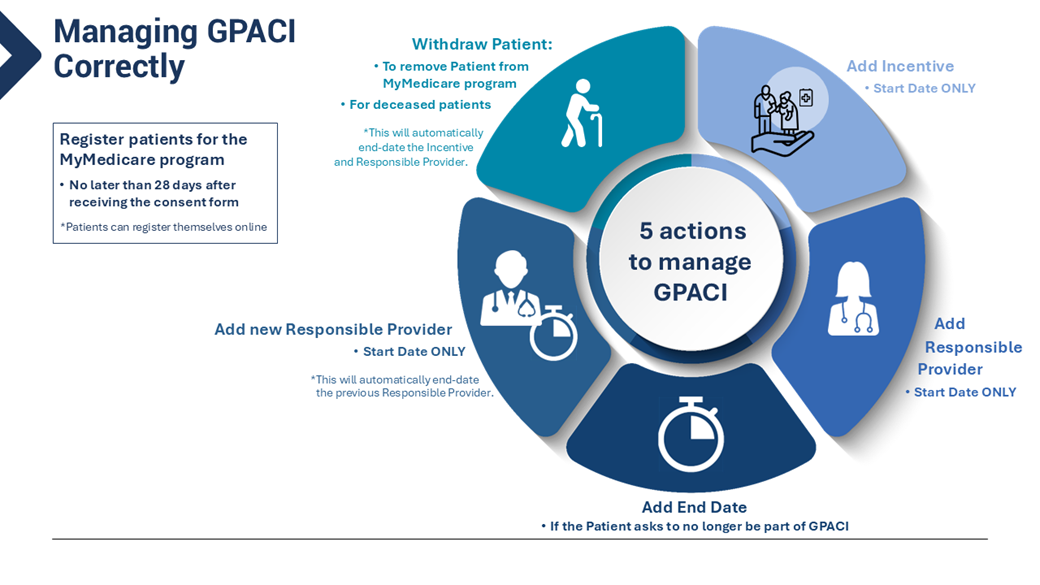
For the Incentive Period:
- DO select “Set period” and add a Start Date to the patient’s MyMedicare profile.
- DO NOT add an End Date; the system will automatically end the Incentive period when necessary.
- DO NOT amend the Start Date unless it was incorrect and you understand the impact on payments.
- DO NOT amend the Incentive period at the start of every new quarter.
- DO NOT delete the Incentive unless it was added in error.
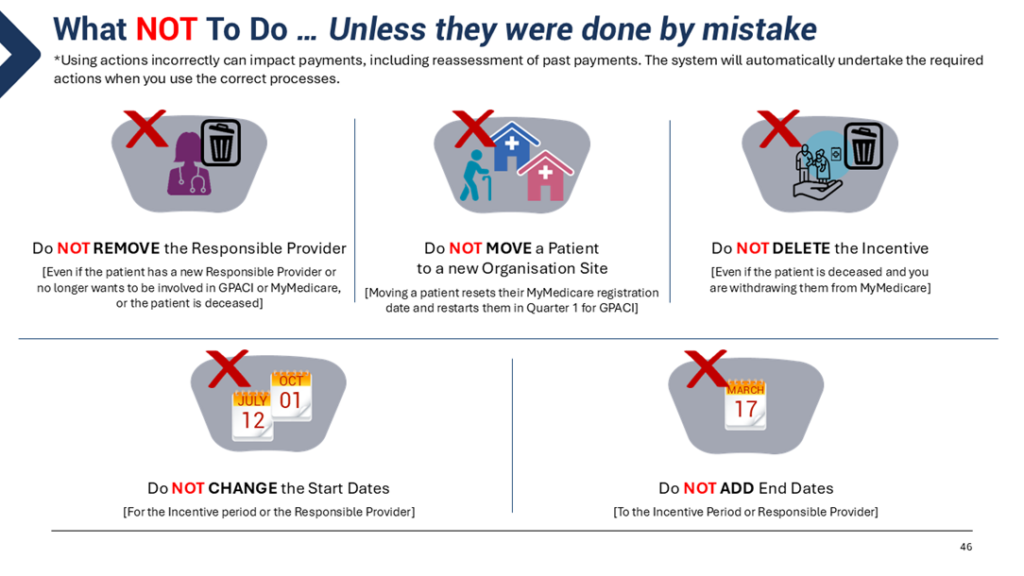
For the Responsible Provider:
- DO add the Responsible Provider and a Start Date.
- DO NOT add an End Date; the system will automatically end the previous Responsible Provider.
- DO NOT amend the Start Date unless it was incorrect and you understand the impact on payments.
- DO NOT remove the Responsible Provider unless added in error.
For the Patient:
- DO register the patient for MyMedicare as soon as possible, no later than 28 days after receiving the consent form.
- DO add GPACI to the patient’s MyMedicare profile.
- DO add a new Responsible Provider if required, only adding a Start Date.
- DO add an Incentive period End Date if the patient requests to leave GPACI.
- DO withdraw the patient if they no longer wish to be part of MyMedicare or are deceased.
- DO NOT remove a Responsible Provider; maintain previous relationships to avoid impacting past payments.
- DO NOT move a patient to a new Organisation Site without understanding the impact on payments.
- DO NOT delete GPACI from a patient’s profile unless added in error.
Short Video Series
South East Melbourne PHN offers brief videos with Dr Billy Stoupas explaining MyMedicare and the General Practice in Aged Care Incentive from a GP’s perspective.
- Video 1 – MyMedicare and an overview of GPACI
- Video 2 – GPACI and service eligibility requirements
- Video 3 – Information on registration
Reminders: Turn on your HPOS mailbox notifications
Your personal or organisational Health Professional Online Services (HPOS) mailboxes often receive numerous messages:
- While some of these may be statements or everyday notifications, some of these are important and require action.
- Turn on notifications to receive alerts for new messages, to save you having to check regularly for new mail.
- Notifications will be sent via Health Professional Online Services (HPOS) mailboxes when payment is made.
*IMPORTANT MESSAGE FOR RESPONSIBLE PROVIDERS: Add bank account details to HPOS for the MyMedicare program or GPACI payments won’t be able to be received. There are some providers who are yet to do this.
For further details contact Practice Assist or your Primary Care Navigator on 08 6278 7900 or via email practiceassist@wapha.org.au
1800 Medicare health information and advice
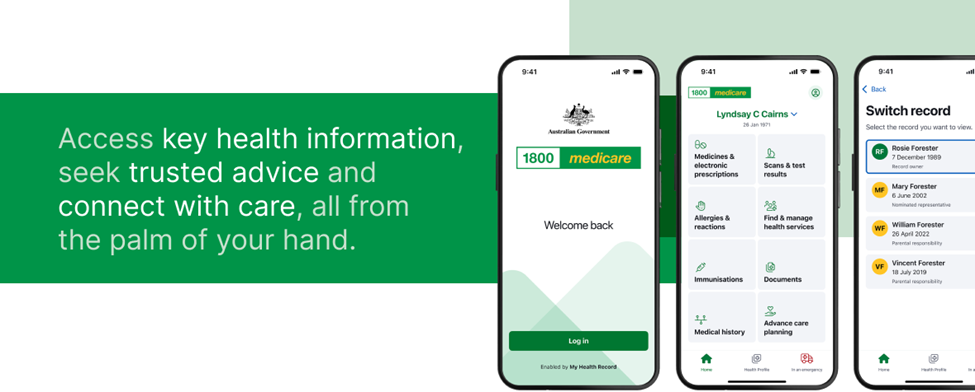
From 1 January 2026, people can access free health information and advice anywhere in Australia, 24/7 by calling 1800MEDICARE (1800 633 422).
Along with the phone service, 1800MEDICARE also includes a website and phone app (formerly my health app).
The app has recently been updated, allowing users to manage and change privacy and access settings, which will also be reflected in My Health Record. The app will automatically update for some people, however others will need to update the app on their phone.
Over time, new features including in-app notifications for preventative screening and reports on tests and scans will be added.
The service is free, available to anyone, anywhere in Australia – a Medicare card is not needed.
1800MEDICARE is part of the Strengthening Medicare initiative, which aims to simplify healthcare access, improve service equity, and reduce pressure on emergency departments.
For further information:
Medicare Mental Health – 1800 595 212

Anyone in Australia can call Medicare Mental Health (1800 595 212) for free mental health, social and emotional wellbeing support that is specific to an individual’s needs and goals. This service is open to those seeking help for themselves, people supporting someone they care about, or health professionals assisting a patient.
When called, experienced staff will help the caller find the right support, whether that’s with one of the Medicare Mental Health services or from another free or low-cost mental health provider.
A national campaign is currently running to increase local awareness and understanding of the Medicare Mental Health Phone Service. Please consider promoting this important service within your practice:
- Call Medicare Mental Health on 1800 595 212 (between 8:30am and 5pm weekdays, except public holidays)
- Go to medicarementalhealth.gov.au to find out more.

Practice Assist news and updates
2026 General Practice Assist Year Planner
The Primary Care Navigator team have created a General Practice 2026 Year Planner
to remind you of important dates including:
- PIP and WIP quarters
- Shared Health Summary Uploads
- Events and Training
- Practice Connect newsletter publication dates
- Other consideration for your practice
The General Practice 2026 Year Planner can be customised to your practice
needs once printed.
Printed copies of the General Practice 2026 Year Planner are now available, contact Practice Assist or your Primary Care Navigator on 08 6278 7900
or via email practiceassist@wapha.org.au

Practice Assist Hours
From 5 January we have made the following changes to our services:
- Operating hours are from 8:30am to 4:30pm Monday to Friday excluding public holidays.
- Our phone number has changed to 08 6278 7900, with the 1800 number no longer in operation.
We look forward to continuing to support WA general practices in 2026.
Practice Assist Website Maintenance

Practice Assist would like to advise that over the next few weeks the Practice Assist website will be undergoing some maintenance to ensure that it is up to date and functioning well to support general practice in WA.
This maintenance may cause some temporary interruptions to website access.
If you experience any issues accessing our website and would like support from the Practice Assist team please contact Practice Assist or your Primary Care Navigator on 08 6278 7900 or via email practiceassist@wapha.org.au
Don’t miss out on funding opportunities for your practice!
Register your practice today at www.wapha.org.au/tender to stay informed and access tender opportunities. Some previous funding opportunities have included:
- Medicare Urgent Care Clinics
- Multidisciplinary Teams in General Practice
- Strengthening Medicare – General Practice (GP) Grants Program
- Palliative Care Champions
- After Hours GP Services
- Endometriosis and Pelvic Pain Program
Preparing for the wet season and flooding

With the Kimberley’s wet season well and truly underway it is important to remain prepared for the impact that wet conditions and potential flooding can have on access to care and people’s health.
Road closures are often in place when flooding occurs which impacts people’s ability to reach the services and receive the care they require. Floodwaters can pose serious health risks due to the potential contamination of drinking water, increased prevalence of respiratory and waterborne illnesses, and a rise in mosquito activity, who can carry various diseases.
General practice can contribute to preparing patients for the effects of the wet season and help reduce the impact to communities. Education is crucial in ensuring patients are equipped with the knowledge and resources to protect themselves during these weather events and potential flooding.
Who is at risk?
- Children, older people, pregnant women, people experiencing homelessness and those living with a disability.
- Patients with asthma or respiratory illness.
- Patients living with chronic conditions and/or on multiple medications.
- Patients who are unable to respond due to dementia, disability, or other factors.
- Aboriginal population living in remote areas.
How can general practice assist?
Encourage patients at most risk to prepare and plan:
- a reliable location to go to in the event of evacuation,
- sufficient medications on hand in the event of supply chain interruption,
- refer patients to the most appropriate sources of information (listed below).
- to utilise digital health tools such as My Health Record, which can assist patient care during emergency situations.
Key information:
- Emergency WA – Emergency warnings for Western Australia up to date warnings.
- Department of Fire and Emergency Services for hazard information – Cyclone and flood information
- Department of Fire and Emergency Services for flood preparations advice.
- ABC Emergency – live updates via internet and radio
- Main roads travel map – for evacuations and road condition tracking.
- The Australian Warning System
Immediate (urgent) referrals to Sir Charles Gairdner and Osborne Park Hospitals (SCGOPHCG)
This is a reminder of the process for ‘immediate’ referrals at Sir Charles Gairdner and Osborne Park Hospitals (SCGOPHCG). Any referral requiring immediate (urgent – within 7 days) review should first be discussed with the relevant specialty’s registrar or consultant by contacting the switchboard on 08 6457 3333.
After discussion, please send the referral to the Single Point of Referral Team (SPoRT) via email sport@health.wa.gov.au or fax to 08 6457 4159. Please ensure you indicate the name of the clinician who accepted the referral on the phone. In some instances, you may be asked to send the referral directly to the relevant team.
All other referrals should continue to be sent to the Central Referral Service (CRS).
IBD in practice: A survey on knowledge and management in primary care
Share your experiences with treating Inflammatory Bowel Disease (IBD). Sir Charles Gairdner Hospital are conducting a survey to understand GP perspectives on the treatment of IBD, the quality of services available, and the educational supports that would be of benefit.

Cold chain breaches

The latest Vaccine Update has alerted that in 2025, WA Public Health Units provided advice for 933 cold chain breaches across the state.
A cold chain breach should be reported immediately to your local Public Health Unit. When breaches are not identified or reported, patients may inadvertently be administered vaccines that have reduced or have no effectiveness.
These incidents may impact patient confidence in immunisation services. It requires time and resources for providers to follow up, counsel patients, and organise re-vaccination.
Immunisation providers are reminded to ensure the following steps are maintained:
- Ensure all temperature excursions below 2oC or above 8oC (excluding those between 8oC and 12oC for 15 mins or less only) are reported to the local Public Health Unit.
- Monitor and document the minimum, maximum and current fridge temperatures twice daily.
- Ensure your fridge has a data logger and is downloaded and reviewed at least once per week.
- If a cold chain breach occurs, isolate the vaccines in the fridge and report the breach to your local Public Health Unit.
- Ensure ALL staff involved in cold chain management have completed the WA Health training module for cold chain management and are familiar with the National Vaccine Storage Guidelines ‘Strive for 5’ and the WA Management of Cold Chain for Immunisation Service Providers guidelines.
Counterfeit rabies vaccine in India
On 9 January 2026, the Health Department of WA released an Infectious Disease alert regarding the circulation of counterfeit Abhayrab rabies vaccines.
These counterfeit vaccines have been in circulation since November 2023 and whilst Abhayrab is not available in Australia, anyone who had the vaccine in India may not be fully protected against rabies.
Public Health has contacted people known to have received Abhayrab or an unknown rabies vaccine in India since 01 November 2023 as part of post-exposure prophylaxis, to provide individual advice.
People who received pre-exposure prophylaxis overseas, or a full post-exposure course overseas or in another state, may not be known to WA public health units and could present to general practice for advice.
Recommended action by general practice is to consider any doses of Abhayab invalid and to recommence the regime with Australian registered vaccines (Rambipur or Verorab).
Read the full statement from Dr Paul Armstrong at WA Department of Health here.
For further advice or information contact our local Public Health Unit.
Increased influenza activity and guidance for the holiday season
The Australian Health Protection Committee (AHPC) notes report of increased influenza in Australia. Several factors may be contributing to this unusual increase, but the main driver is most likely infections with influenza A(H3N2) virus, in particular a new subclade called subclade K. While there is no indication of increased severity of illness, the increase in infections may put increased pressure on our nation’s healthcare services, as well as increase the risk of serious illness especially in older people, young children, people who are pregnant or breast feeding, Aboriginal and Torres Strait Islander people, and those who have serious medical conditions.
The AHPC recommends that your patients take the following actions:
- Stay at home if you have flu like symptoms
- If you have not yet had a 2025 influenza vaccination, it is not too late
- People travelling to the Northern Hemisphere should consider having an influenza vaccine
- If you are at risk of becoming seriously unwell with influenza, have a plan in place for early testing and access to antiviral medications.
To read the full AHPC statement, click here.

National Cancer Screening Register integration

The National Cancer Screening Register (NCSR) is a digital platform that supports, facilitates and streamlines engagement in the National Bowel Cancer Screening Program, National Cervical Screening Program, and National Lung Cancer Screening Program for eligible participants and their health care providers.
The NCSR provides a single electronic record for each participant and delivers a secure, national infrastructure for collecting, storing, analysing and reporting screening data.
Health care providers can access participants’ cancer screening information and manage participation in the bowel, cervical, and lung cancer screening programs through secure online portals and integrated clinical software.
Clinical software integration

Integration is designed to streamline workflows for health care organisations, allowing you to access and report patient clinical information for the bowel, cervical and lung cancer screening programs directly from the software you use every day.
Health care organisations using integrated software can:
- Support patient participation: Access patient bowel, cervical and lung cancer screening information and status (including overdue and follow-up alerts), and enrol patients in the National Lung Cancer Screening Program.
- View and submit screening results: Including colonoscopy, colposcopy findings or radiology reports, ensuring accurate program participation.
- Order bowel screening program test kits: Directly to a patient’s address or record when you have issued one to a patient during a consultation as part of the alternative access to kits model (bulk orders are made through the Healthcare Provider Portal).
- Verify and update patient contact details and demographic information.
- View screening program-related correspondence: Stay updated with program communications to track your patient’s screening journey.
- Nominate health care providers or personal representatives: Assign a health care provider or personal representative to ensure comprehensive patient care.
Currently integration can be done with the following software: BP Premier, Communicare, Medical Director and MMEx.
WA Primary Health Alliance bowel screening integration project
WA Primary Health Alliance (WAPHA) is currently assisting eligible practices to navigate the integration process. If necessary, we can visit the practice, showcase NCSR and provide necessary support through the integration process.
For further information of the assistance we offer, email Violet.Corrigan@wapha.org.au
To learn more about integration, access here.

Nurse Forum 2026 – Primary Care Nurses Day Celebration
Presented by WA Primary Health Alliance
4 February (5:30pm – 8pm)

WA Primary Health Alliance (WAPHA) invites you to attend the Nurse Forum 2026 – Primary Care Nurses Day Celebration.
With the theme of Sustaining Primary Care Nursing: Wellbeing in Practice, the forum aims to provide a dedicated and supportive space for practice nurses from across our region to connect, reflect and strengthen their role within primary care.
To find out more, view the flyer and register today.
Practice Manager Virtual Networking Session
Presented by WA Primary Health Alliance
5 February (11am to 12pm)

Join us for the first Practice Manager Virtual Networking Session to connect, discuss topics of interest, share information and raise questions with your WAPHA support team and other local general practices.
When you register, you can indicate which topics you would like to be discussed. The topics could be about anything that is important to your practice or information on practice-related matters such as accreditation, reform measures, incentives, MyMedicare, digital health, quality improvement, immunisation, cancer screening or WAPHA programs and projects.
To find out more, view the flyer and register for session one today.
Webinar: Overview of refugee health
Presented by WA Primary Health Alliance
18 February (6pm to 8pm)

Join us for the first webinar in a six-part series about refugee health in primary care, presented in conjunction with WA Health.
The first webinar on Wednesday 18 February will provide an overview of refugee health and cover the following topics:
- The global and Australian context when working with refugees, asylum seekers and displaced people.
- The impact of adverse experiences and social determinants of health.
- The diversity that is present within refugee communities.
- The role of the Humanitarian Settlement Program (HSP) provider and refugee health services in WA and how these intersect with primary care.
To find out more, view the flyer and register today.
Honour-based violence in Culturally and Linguistically Diverse (CALD) communities
Presented by WA Primary Health Alliance
23 February (6pm to 8pm)

A practical session designed to help GPs, practice nurses and relevant clinical staff identify and respond to honour-based violence in culturally and linguistically diverse communities. Learn culturally safe, trauma-informed strategies and gain confidence in initiating sensitive conversations and making appropriate referrals.
APNA Mental Health First Aid
Presented by APNA and supported by WA Primary Health Alliance
3 March to 12 March (various locations)
Mental health matters. One in five Australians experience mental health concerns each year, and primary health care nurses are often the first point of support.
Join APNA’s Mental Health Education Program—designed for nurses, by nurses—to build the skills, knowledge, and confidence to make a real difference.
- Expert-led sessions by APNA nurse & licensed MHFA instructor
- Practical strategies for early intervention
Format: approx. 7 hours of online learning (to be done first) + hard-copy workbook posted to you + 5hr face-to-face workshop
Locations: South Metro Perth, Kalgoorlie, Geraldton, Broome, North Metro Perth, Bunbury
Places are limited – view the flyer for more information.
Practice Manager Forum: Futureproofing your general practice
Presented by WA Primary Health Alliance
27 March (9am to 3pm)

Join us for an engaging and informative in-person event designed to support WA general practices with navigating key changes, embracing innovation and strengthening quality improvement.
General practice is evolving rapidly, from accreditation reforms and privacy legislation updates to the integration of AI and digital tools.
The Practice Manager Forum will bring together primary care professionals to explore these changes, share insights and connect with support programs that enhance practice sustainability and patient care.
To find out more, view the flyer and register today.
Free accredited training in disaster preparedness for general practice
Presented by WA Primary Health Alliance
Ongoing e-learning training
Western Australia faces recurring bush fires, floods and other natural disasters, and GPs are the local health professionals working in the community before disasters strike and remain after responders leave.
Provided at no cost to the practice, “Building capacity in disaster preparedness and response for general practice” is a bespoke, accredited* online learning package from WAPHA designed to equip GPs, and practice teams to manage patient flow, prioritise resources, and maintain continuity of care, particularly for those with chronic conditions and mental health needs.
Taking approximately 12 hours to complete (at your own pace), with modules tailored to specific roles within the practice team, participants will learn:
- Practical strategies for disaster preparedness, response, and recovery in primary care
- Maintaining continuity of care and managing patient demand during crises
- Resource prioritisation and supporting priority populations
- Coordinating with local health districts, emergency services and public health agencies
- Building practice resilience, safety systems and structured disaster management processes.
*RACGP Accredited for 11.5 hours (6 EA, 3 RP and 2.5 MO).
Rural and remote retrieval weekend
Presented by Rural Health West
7 to 10 May (Karijini National Park)
Join Rural Health West in one of Australia’s greatest and most spectacular landscapes – the truly magnificent Karijini National Park.
By day be spellbound by the contrasting Pilbara blue skies against the classic red rock formations, as you wind your way through gorges to undertake emergency medical scenarios. At night, socialise under a canopy of stars with fellow participants.
The weekend provides participants with the opportunity to learn about the management of medical emergencies in a remote environment with limitations in equipment, personnel and resources.
Other Webinars, Events & Workshops
| STI Testing in Primary Care: Western Australia Presented by ASHM Ongoing learning module and webinar |
| Enhancing Syphilis Awareness: Engaging Communities and Health care Providers Presented by ASHM Ongoing learning module and webinar |
| BreastScreen WA mobile visit to Serpentine Presented by BreastScreen WA 22 January to 11 February |
| BreastScreen WA mobile visit to Exmouth Presented by BreastScreen WA 22 January to 6 February |
| BreastScreen WA mobile visit to Bullsbrook Presented by BreastScreen WA 30 January to 13 February |
| Managing patient depression and suicidality in primary care Presented by Rural Health West February to June |
| BreastScreen WA mobile visit to Pinjarra Presented by BreastScreen WA 2 February to 3 March |
| National Hepatitis B s100 Prescriber Course Presented by ASHM 3 February and 10 February |
| WA HIV s100 Prescriber Course Presented by ASHM 7 February and 8 February |
| Wesley Lifeforce Primary Care Support Staff (non-clinical) Suicide Prevention Training 2026 (Connolly, Perth northern suburbs) Presented by Wesley Mission 9 February |
| Perth Gender Network Meeting Presented by RACGP 10 February |
| BreastScreen WA mobile visit to Carnarvon Presented by BreastScreen WA 10 February to 9 March |
| BreastScreen WA mobile visit to Byford Presented by BreastScreen WA 12 February to 18 March |
| PHPN Welcome to 2026 Sundowner (Hedland) Presented by Pilbara Health Professionals Network (PHPN) 13 February |
| Certificate in Sexual and Reproductive Health: In-person nurses’ course Presented by SHQ 16 to 19 February |
| Contraceptive Implant Theory: In-person training Presented by SHQ 16 February |
| BreastScreen WA mobile visit to Fremantle Presented by BreastScreen WA 16 February to 25 March |
| Cervical Screening Training: In-person Presented by SHQ 18 to 19 February |
| PHPN Welcome to 2026 Sundowner (Karratha) Presented by Pilbara Health Professionals Network (PHPN) 20 February |
| De-escalation Skills Presented by Western Australian Association for Mental Health 24 February, 9 April and 29 June |
| Wesley Lifeforce Primary Care Support Staff (non-clinical) Suicide Prevention Training 2026 (Online workshop) Presented by Wesley Mission 25 February |
| BreastScreen WA mobile visit to Waroona Presented by BreastScreen WA 4 March to 20 March |
| Sexual and Reproductive Health Australia National Certificate for Doctors: In-person Presented by SHQ 9 to 13 March |
| Wesley Lifeforce Primary Care Support Staff (non-clinical) Suicide Prevention Training 2026 (Wanneroo) Presented by Wesley Mission 9 March |
| Understanding Vicarious Trauma: Tools for helping professionals Presented by Western Australian Association for Mental Health 11 March and 8 May |
| WA Rural Health Conference 2026 Presented by Rural Health West 14 March and 15 March |
| Course in Ear Wax Removal (Microsuction) Presented by Benchmarque Group 26 March |
| Course in Ear Wax Removal (Irrigation) Presented by Benchmarque Group 27 March |
| National Hepatitis B s100 Prescriber Forum Presented by ASHM 27 March |
| Wesley Lifeforce Primary Care Support Staff (non-clinical) Suicide Prevention Training 2026 (Busselton) Presented by Wesley Mission 14 April |
| Wesley Lifeforce Primary Care Support Staff (non-clinical) Suicide Prevention Training 2026 (Bridgetown) Presented by Wesley Mission 16 April |
| National Suicide Prevention Conference Presented by Suicide Prevention Australia 28 April to 30 April |
Acknowledgement
WA Primary Health Alliance acknowledges and pays respect to the Traditional Owners and Elders of this country and recognises the significant importance of their cultural heritage, values and beliefs and how these contribute to the positive health and wellbeing of the whole community.